
American Preeminence in the 21st Century
For more than a decade, predictions of American decline have become almost conventional wisdom.
China has risen with extraordinary speed. Russia has reemerged as a military threat. American political divisions have deepened. The national debt has grown. Manufacturing capacity has migrated overseas. New technologies are challenging advantages the United States once took for granted.
From this, an increasingly common conclusion has emerged:
The American era is ending.
Perhaps.
But that conclusion assumes something that is far from certain—that another country possesses the foundations necessary to replace the United States.
China is usually offered as the obvious successor. Its accomplishments are formidable. In barely a generation, China became the manufacturing center of the world, constructed immense infrastructure, developed sophisticated technological industries, and built military forces capable of presenting the United States with a serious challenge in the Western Pacific.
Yet the assumption that China’s rise will continue indefinitely deserves considerably more scrutiny.
China is entering one of the most difficult demographic transitions experienced by any major power. Its population is aging rapidly, its workforce faces long-term contraction, and low fertility means future generations will be asked to support an increasingly large elderly population. The World Bank has specifically identified a declining labor force and rapid aging as constraints on future Chinese growth.
At the same time, decades of investment-driven growth have produced enormous imbalances. Property development, local-government borrowing, infrastructure construction, and state-directed investment generated remarkable growth, but also significant debt and increasingly inefficient capital allocation. The IMF and World Bank have both highlighted the interconnected challenges posed by China’s property sector, local-government indebtedness, weak domestic consumption, and slowing productivity.
Then there is geography.
China is surrounded by major powers, contested borders, mountainous frontiers and strategically vulnerable maritime approaches. Much of the trade and energy that supports the Chinese economy must cross seas and chokepoints thousands of miles from Beijing’s control.
None of these problems mean China is destined to fail. It will almost certainly remain one of the world’s most powerful countries for decades.
But great-power competition is not determined simply by extrapolating yesterday’s growth rates into tomorrow.
To understand whether the United States is truly entering decline, we should begin somewhere much more fundamental.
We should begin with the land itself.
The Geography That Built a Superpower
Long before the United States possessed aircraft carriers, Silicon Valley, Wall Street or the world’s largest economy, it possessed something perhaps even more valuable:
An extraordinary piece of real estate.
Few major powers in history have enjoyed a comparable combination of natural advantages.
The continental United States sits between the Atlantic and Pacific Oceans. To its north lies Canada; to its south, Mexico. Neither represents a serious military threat to American territory.

Compare this with the historical circumstances facing virtually every other great power.
Germany sits on the North European Plain, surrounded by neighbors and historically vulnerable from multiple directions.
Russia has repeatedly sought strategic depth because its enormous western approaches provide few natural barriers against invasion.
China shares land borders with more than a dozen countries and faces major powers including Russia and India, while its economically crucial coastline opens onto seas bordered by Japan, South Korea, Taiwan and the Philippines.
The United States, meanwhile, effectively developed behind two enormous moats.
But America’s geographic advantage extends far beyond protection.
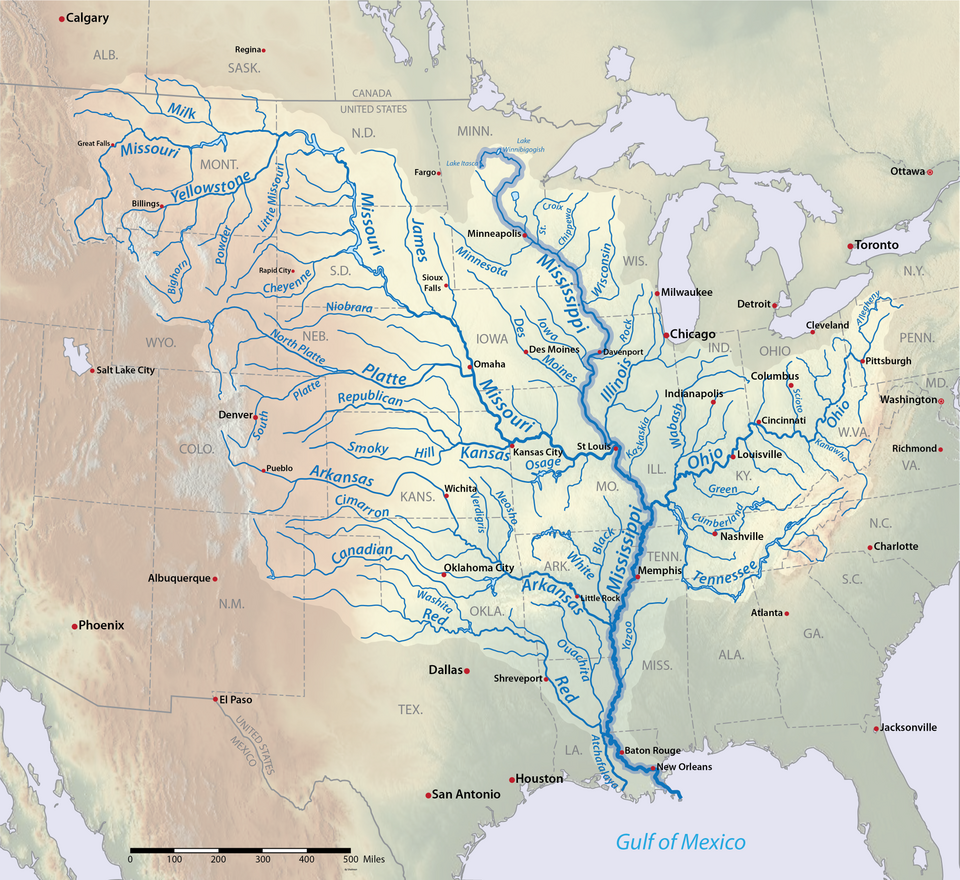
The Mississippi River and its tributaries form the backbone of an enormous internal transportation system connecting much of the country’s agricultural and industrial heartland directly to the Gulf of Mexico. Today the Army Corps of Engineers maintains roughly 12,000 miles of inland and intracoastal waterways, while the broader American marine-highway system stretches more than 27,000 miles.
For much of American history, this mattered enormously.
Before railroads and interstate highways, moving a ton of wheat, timber, coal or manufactured goods overland was expensive. Moving the same cargo downstream by water was comparatively cheap.
The Louisiana Purchase therefore did more than double the physical territory of the young United States.
It secured the Mississippi River system and ultimately the commercial outlet at New Orleans.
That meant farmers hundreds of miles inland could participate in international trade.
A farmer in Ohio, Kentucky or Missouri did not need to haul his crop across a continent. The river carried it toward the Gulf and from there into the world economy.
As settlement pushed westward, waterways turned continental expansion into economically productive expansion.
The Erie Canal performed a similar function in the northeast, connecting the Great Lakes to the Hudson River and dramatically lowering the cost of moving goods between America’s interior and the Atlantic.
Chicago eventually became a great commercial center partly because it sat near the meeting point of the Great Lakes and Mississippi transportation systems.
St. Louis grew where the Missouri and Mississippi converged.
New Orleans commanded the gateway between America’s enormous river basin and global markets.
Geography helped determine economics.
And economics helped determine power.
The American interior also contains enormous quantities of highly productive farmland.
Technological innovation has multiplied that advantage. According to the U.S. Department of Agriculture, American farm output nearly tripled between 1948 and 2023 while total agricultural inputs increased only modestly—an extraordinary increase in productivity.
Corn, wheat, soybeans and livestock can be produced on a continental scale, transported inexpensively through rivers and rail networks, and exported through ports connected to both oceans.
The result is something remarkably rare among great powers:
A vast country with abundant food, enormous internal transportation capacity, tremendous natural resources, direct access to the world’s two largest oceans and comparatively little military pressure along its land borders.
America’s rise was never guaranteed.
But geography made that rise dramatically easier.
And unlike factories, governments or technologies, geography doesn’t depreciate.
The United States enters the twenty-first century occupying fundamentally the same extraordinary piece of land that helped propel it to power in the nineteenth.
Geography Created an Efficient Capital Machine
The consequences of favorable geography compounded over time.
Cheap internal transportation connected American producers with a rapidly expanding domestic market.
Agricultural surpluses generated wealth.
Industrial centers emerged alongside waterways, railroads and ports.
Two-ocean access connected American businesses with Europe and Asia.
And because the continental United States remained relatively insulated from the repeated devastation that afflicted Europe and Asia, capital could accumulate across generations.
That matters.
Capital is ultimately stored economic capability—the ability to take resources that exist today and invest them in something that may produce more value tomorrow.
Few countries have ever accumulated it on America’s scale.
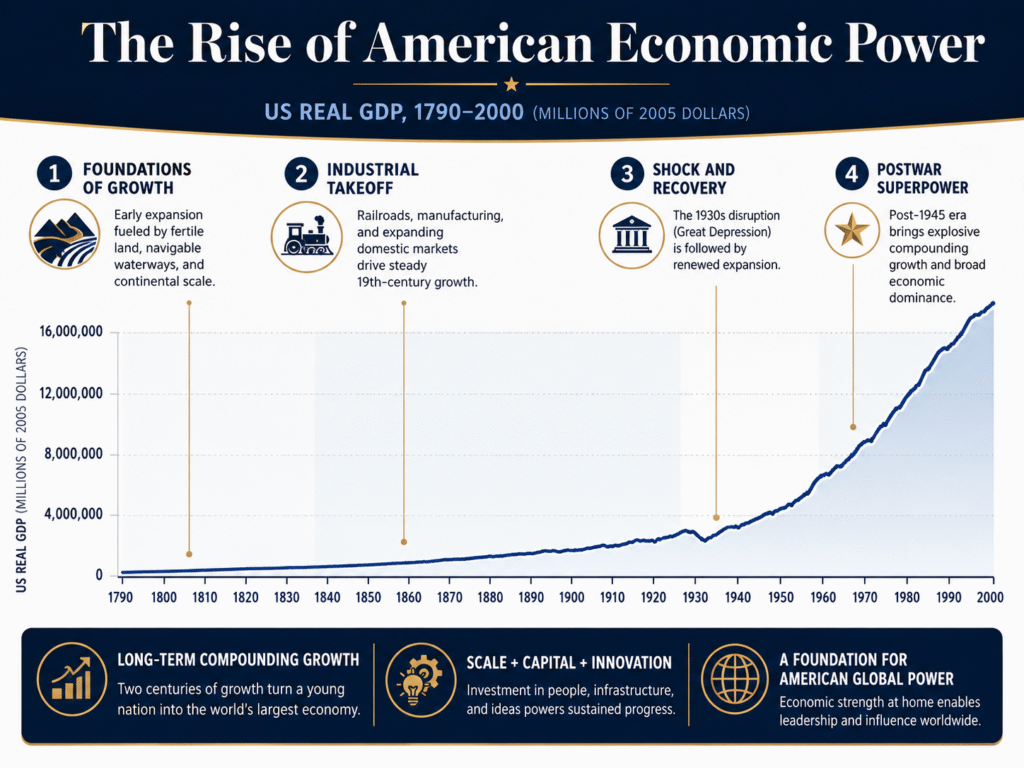
Wall Street became more than a collection of banks. It became an enormous mechanism for matching ideas with money.
Railroads provide one of the earliest examples.
Building transcontinental rail systems required extraordinary quantities of capital before the first passenger ever purchased a ticket. American financial markets helped mobilize that capital, allowing railways to connect distant producers and consumers and integrate a continental economy.
The same process later financed steel mills, electrical systems, automobiles, aircraft, telecommunications networks and computing.
Today the American Treasury market is widely regarded as the deepest and most liquid securities market in the world, while Federal Reserve research describes the overall depth and liquidity of U.S. financial markets as unmatched.
That depth matters beyond finance.
It means American companies can raise extraordinary amounts of money.
Entrepreneurs can obtain venture capital.
Established corporations can issue bonds.
Governments can finance infrastructure.
Homeowners can obtain long-term mortgages.
Pension funds can invest at scale.
And investors from virtually everywhere on Earth can place capital into American markets.
Consider what this means during periods of technological transformation.
A promising technology does not merely require an inventor.
It requires laboratories.
Engineers.
Factories.
Servers.
Equipment.
Distribution networks.
Marketing.
Workers.
Years of losses before profitability.
All of those things require capital.
America developed the deepest reservoir of investable capital in human history—and an institutional system unusually capable of deploying it.
But money alone does not create technological leadership.
It needs people capable of turning money into something new.
That leads to another pillar of American power.
The University’s Role in American Power
The United States built what is arguably the most formidable university ecosystem in the world.

Harvard.
MIT.
Stanford.
Caltech.
Princeton.
Berkeley.
Carnegie Mellon.
Georgia Tech.
The University of Michigan.
The University of Texas.
And dozens of others.
The importance of this system is not simply that American universities confer prestigious degrees.
They function as research engines.
They train scientists and engineers.
They operate laboratories.
They conduct basic research that private companies frequently cannot justify funding themselves.
They attract talented students and researchers from throughout the world.
And they exist inside a broader ecosystem connecting government research funding, private industry and entrepreneurial capital.
The National Science Foundation describes STEM talent, research-driven discovery and the translation of knowledge into innovation as central to American competitiveness. It also notes the disproportionate contribution made by foreign-born scientists and engineers, particularly at the doctoral level.
That last point is easy to underestimate.
For generations, some of the world’s most talented scientists, engineers and entrepreneurs have left their home countries and come to the United States.
Instead of merely competing against foreign talent, America has historically absorbed a meaningful portion of it.
That turns immigration into something beyond population growth.
At its best, it becomes intellectual arbitrage.
Other societies educate brilliant people.
America frequently convinces them to build their careers here.
And when those people emerge from American universities, they encounter something unusual:
The largest pools of private capital on Earth sitting only a few steps away.
The Demographic Advantage
There is another source of national power that receives less attention than aircraft carriers, technology companies or oil production.
People.
Demography does not determine the fate of nations by itself. Rich countries can remain productive with aging populations. Automation can compensate for labor shortages. Immigration can replenish workforces. Productivity can rise even as population growth slows.
But over sufficiently long periods, demographics impose constraints that governments cannot easily escape.
A country with a growing or relatively stable working-age population possesses more potential workers, consumers, taxpayers, entrepreneurs and military recruits. A rapidly aging society must increasingly divert resources toward pensions, healthcare and elder care while a shrinking number of workers supports a growing retired population.
Here, too, the United States enters the twenty-first century from an unusually favorable position.
America is aging.
Birth rates have fallen below the level required for long-term population replacement without immigration, and the enormous Baby Boom generation is moving into retirement. The Census Bureau projects that older Americans will constitute an increasingly large share of the population and that natural population growth will continue to weaken.
So the United States is not immune to the demographic pressures affecting most developed societies.
The difference is degree—and flexibility.
Current Census projections still have the American population growing for most of this century under their main scenario, reaching nearly 370 million around 2080 before beginning a modest decline. Immigration is a major reason the United States can maintain that balance even as fertility falls and the population ages.

That gives America something enormously valuable: time.
It does not need extraordinarily high birth rates to maintain a large workforce. It does not need to reverse aging overnight. It can supplement domestic population growth by continuing to attract people from elsewhere in the world.
And for more than two centuries, that has been one of America’s great competitive advantages.
Immigration expands the labor force, creates consumers and taxpayers, and—when paired with America’s universities and capital markets—can import human capital as well as population.
The engineer educated in India.
The physicist born in Europe.
The software developer from Latin America.
The entrepreneur from Taiwan.
The researcher from Africa.
When they move to the United States, the demographic advantage becomes an economic and technological advantage as well.
That ability makes the American demographic problem fundamentally different from the one confronting several of its competitors.
China provides the most important example.
For decades, China’s enormous population was one of the foundations of its economic rise. Hundreds of millions of workers moved from the countryside into rapidly industrializing cities. An expanding workforce supplied factories, construction projects and export industries. A relatively small retired population meant that an unusually large share of the country could participate directly in economic production.
That demographic dividend is ending.
China’s population has begun to decline, its workforce is aging, and decades of low fertility mean there are far fewer young Chinese entering the population behind them. The World Bank now identifies rapid aging and a shrinking labor force as significant constraints on China’s future economic growth.
The long-term projections are striking.

The United Nations expects China’s population to fall dramatically during this century; under its central projections, the country could lose more than half of its present population by 2100.
The immediate problem is not simply that there will be fewer Chinese citizens.
It is the changing ratio between generations.
The enormous cohorts that powered China’s industrial expansion are moving toward retirement. Behind them are much smaller generations of workers who will be expected to support pension systems, healthcare systems, local governments and elderly parents while simultaneously sustaining economic growth.
And unlike financial debt, demographic deficits cannot be quickly refinanced.
A factory can be built in three years.
An aircraft carrier can be constructed in a decade.
A semiconductor industry can be subsidized.
But a missing generation cannot be created retroactively.
Even a dramatic increase in Chinese birth rates tomorrow would not produce additional twenty-five-year-old engineers, factory workers or soldiers until the middle of the century.
That makes demographic change unusually powerful.
Its consequences arrive slowly enough to be ignored—then persist for decades.
China is hardly alone.
Japan, South Korea and much of Europe face variants of the same problem. Birth rates across the developed world have fallen sharply, and aging populations will place increasing pressure on government finances and labor markets.
The United States faces these pressures as well.
But America possesses a release valve that few other major powers have demonstrated an equivalent ability to use.
People still want to come here.
That matters enormously.
A country capable of attracting ambitious young workers from around the world can partially offset falling domestic fertility. More importantly, when those immigrants enter the same ecosystem of universities, laboratories, companies and capital markets described earlier, America does more than replace workers.
It acquires talent.
That advantage should not be taken for granted.
Immigration must be managed. Social cohesion matters. Infrastructure and housing must expand alongside population. An immigration system that cannot distinguish between the skills the economy needs and uncontrolled population flows can create its own political and economic problems.
But strategically, the ability to attract and assimilate people remains an extraordinary national asset.
America therefore occupies something close to a demographic middle ground.
It is not a youthful developing country facing explosive population growth.
Nor is it yet a society facing the scale of population contraction projected for China and several East Asian economies.
Instead, it has a large existing population, comparatively favorable age structure, substantial immigration potential and an economy capable of absorbing human capital from almost anywhere on Earth.
That balance reinforces nearly every other American advantage.
More workers expand the economy.
More consumers deepen the domestic market.
More taxpayers support national institutions.
More engineers feed the technology sector.
More entrepreneurs start companies.
More students strengthen universities.
And immigration allows the United States to compete not merely for capital and technology, but for one of the most valuable resources of the twenty-first century:
Human talent.
Where Capital Meets Talent
This combination may represent America’s most important economic advantage.
Deep capital markets exist elsewhere.
Excellent universities exist elsewhere.
Talented entrepreneurs exist everywhere.
What the United States has repeatedly done better than any other country is connect all three.
The modern technology industry provides the most obvious example.
Stanford University sits in the heart of Silicon Valley.
Researchers, engineers and entrepreneurs emerge from universities into an ecosystem filled with venture-capital firms willing to finance companies that may have no profits, few assets and—in some cases—little more than a promising idea.
Most fail.
That is part of the system.
The winners can transform industries.
Intel.
Apple.
Microsoft.
Google.
Amazon.
Nvidia.
Meta.
Tesla.
SpaceX.
OpenAI.
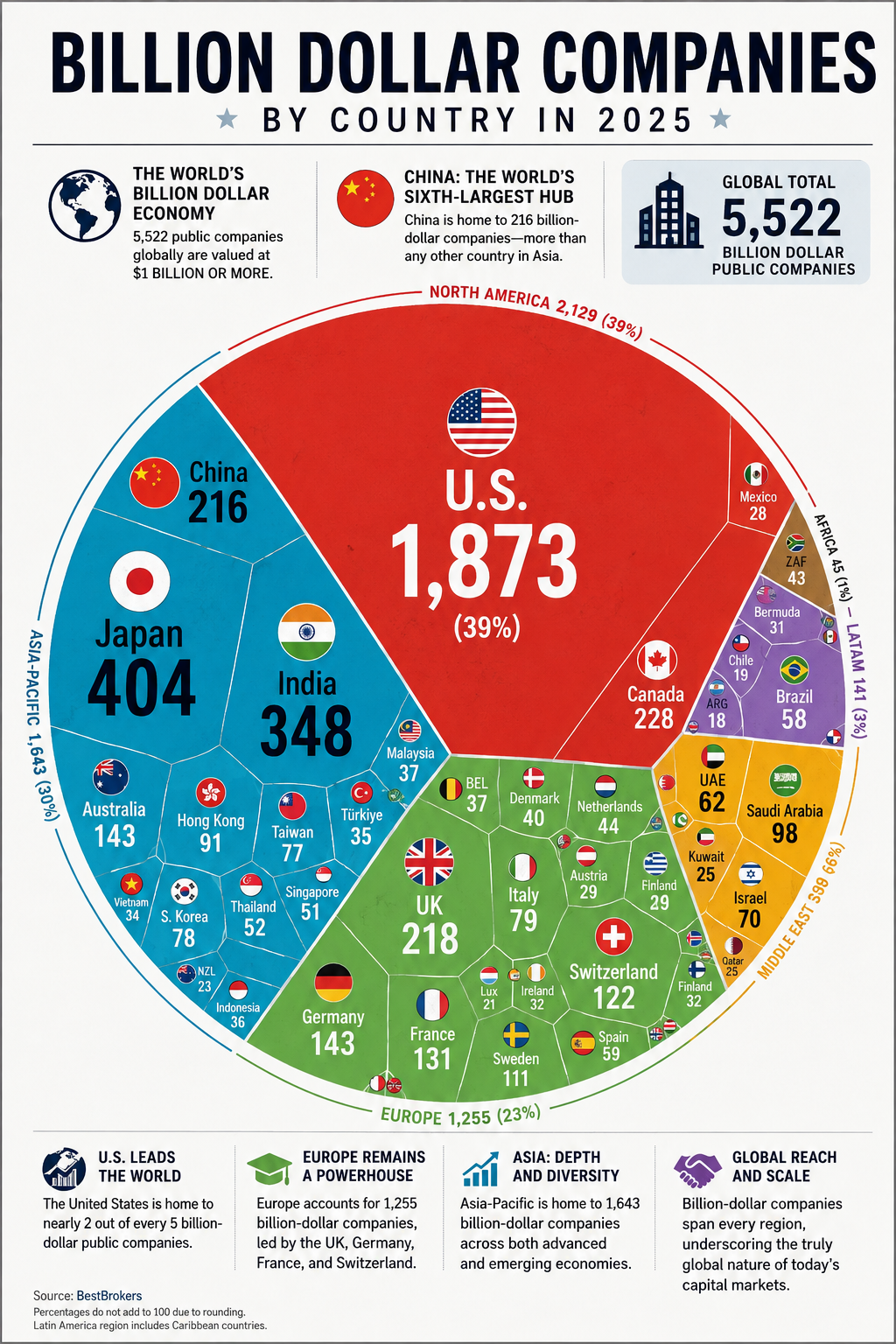
The list changes from generation to generation, but the pattern remains remarkably consistent.
Technological breakthroughs emerge from combinations of government-funded research, university laboratories, private entrepreneurship and enormous quantities of risk capital.
The semiconductor industry grew from advances in physics and electronics.
The internet developed from government-supported research before becoming the foundation for enormous private industries.
Biotechnology emerged from advances in molecular biology and university research.
Modern artificial intelligence grew out of decades of work conducted across universities, government laboratories and private companies before enormous amounts of commercial capital accelerated development.
The defining feature isn’t any single company.
It is the mechanism that repeatedly creates them.
America has built a system capable of turning knowledge into businesses at extraordinary speed.
A professor develops an idea.
A graduate student commercializes it.
A venture fund provides $10 million.
More investors provide $100 million.
Public markets eventually provide billions.
Employees move between firms.
Companies fail.
Their engineers join new companies.
Successful founders become investors themselves.
Capital and knowledge recycle.
It is messy, wasteful and occasionally absurd.
It is also enormously productive.
And occasionally that same mechanism unlocks resources that were hiding beneath American soil all along.
The Energy Revolution Beneath America’s Feet
At the beginning of the twenty-first century, American energy discussions frequently revolved around scarcity. Domestic oil production had declined for decades. Imports were rising. Energy security was a central geopolitical concern.
Predictions of increasingly scarce petroleum were widespread.
Then something extraordinary happened.
American engineers combined two technologies that had existed for years—horizontal drilling and hydraulic fracturing—and learned how to economically extract oil and natural gas trapped inside shale formations.
Capital poured in.
Drilling accelerated.
Productivity improved.
Costs fell.
The Permian Basin, Bakken, Eagle Ford, Marcellus and other formations were transformed.
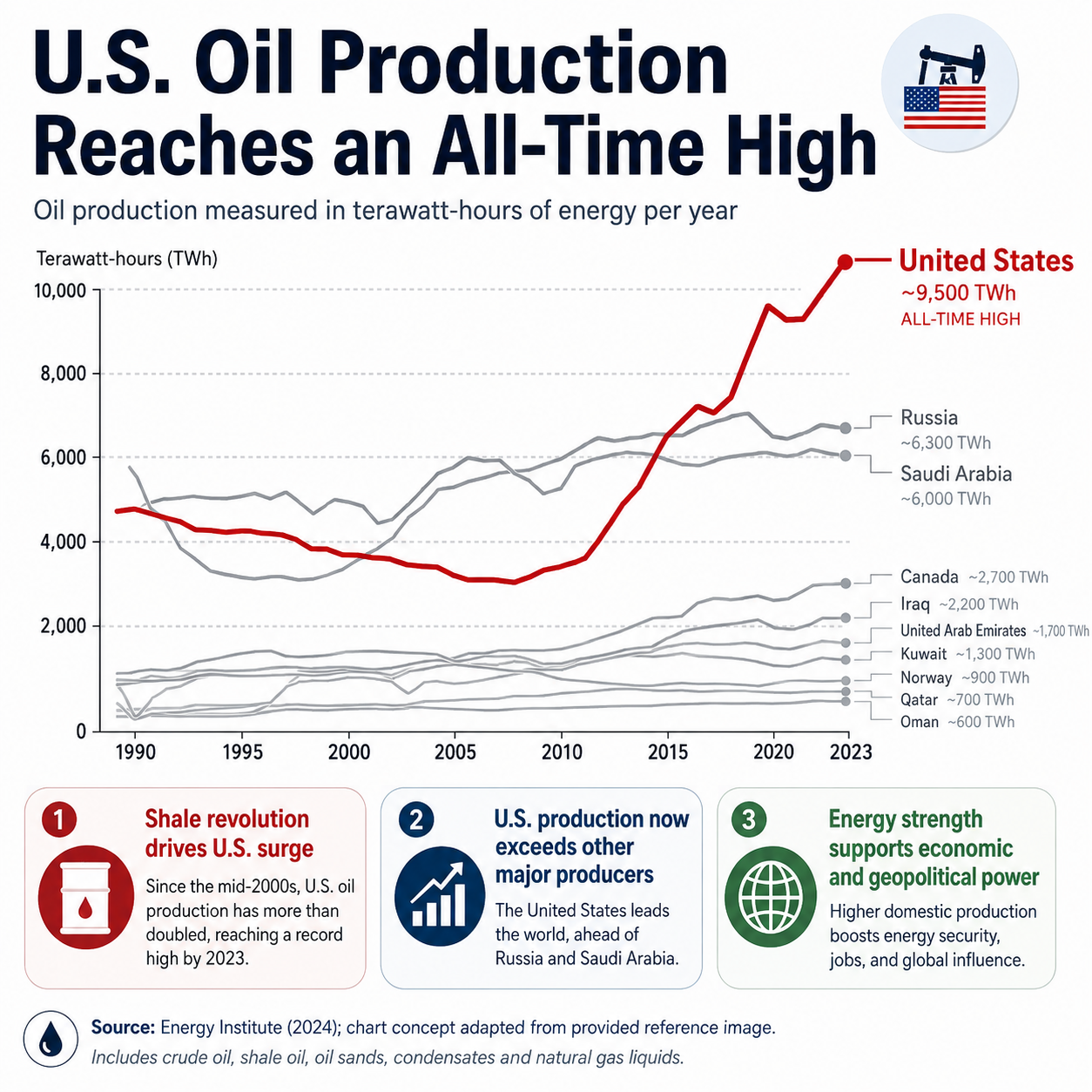
The result was one of the greatest energy expansions in modern history.
The International Energy Agency has described the shale revolution as having transformed the United States into the world’s leading producer of oil and natural gas and fundamentally reshaped global energy markets.
This is another example of America’s advantages reinforcing one another.
The geology had always existed.
But geology alone wasn’t enough.
Shale required engineers capable of developing increasingly sophisticated drilling techniques.
It required mineral rights and a legal structure that allowed landowners and companies to profit from development.
It required thousands of independent operators willing to experiment.
And above all, it required enormous amounts of capital.
Banks lent money.
Private-equity firms backed producers.
Bond markets provided financing.
Public investors funded drilling programs.
Companies failed.
Other companies bought their assets and improved the techniques.
Technology advanced through relentless commercial experimentation.
America’s geography supplied the resource.
Its universities and technical institutions supplied the expertise.
Its capital markets supplied the money.
Its entrepreneurial economy connected them.
Within roughly a decade, the strategic implications were enormous.
A country once worried about dependency on Middle Eastern oil became a massive producer and exporter of energy.
Cheap and abundant natural gas supported industry and electricity generation at home.
American LNG terminals began supplying allies abroad.
And energy became not simply an economic asset, but a geopolitical one.
Yet economic strength alone does not make a great power.
Ultimately, a great power must also be capable of defending the system that produced it.
The Ability to Project Power
There are militaries larger than individual branches of the United States armed forces.
There are countries with formidable missile arsenals, nuclear weapons, advanced aircraft and increasingly capable navies.
But no other country possesses America’s ability to project sustained military power across the planet.
The distinction is important.
Building a capable regional military is extraordinarily difficult.
Building one that can fight thousands of miles from home is harder still.
The United States operates aircraft carriers, nuclear-powered submarines, strategic bombers, aerial-refueling fleets, transport aircraft, satellites, global communications networks and an enormous logistical architecture designed to move people and equipment across continents and oceans.
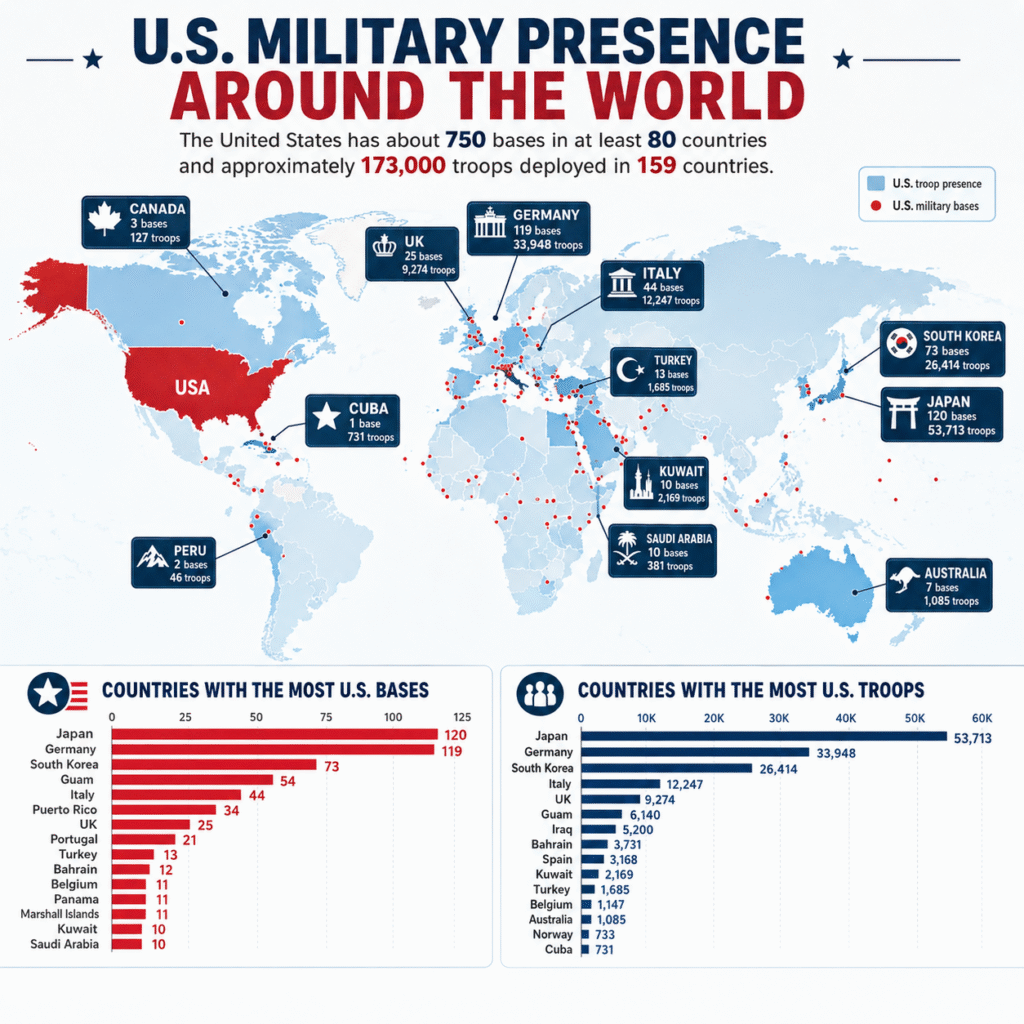
An American combat aircraft can deploy halfway around the world and arrive at an airfield where fuel, weapons, maintenance equipment and trained personnel are already waiting.
A carrier strike group can operate thousands of miles from the continental United States.
American submarines can remain submerged for months.
Strategic airlift can transport troops and equipment between continents in hours.
Military satellites support navigation, communications, intelligence and targeting on a global scale.
This is the part of military power that is frequently overlooked.
Weapons are visible.
Logistics are not.
Yet logistics determine whether weapons matter.
The United States spent decades building military infrastructure around the world—airfields, ports, depots, communications facilities, prepositioned equipment and relationships with foreign militaries.
That infrastructure allows American military power to move beyond American territory.
China has developed an increasingly sophisticated force capable of imposing enormous costs on the United States in East Asia.
Russia remains a nuclear superpower and possesses formidable military capabilities.
But neither possesses an equivalent global architecture.
And much of America’s global military reach rests upon another advantage that is even harder to reproduce.
The Alliance System
The United States does not operate alone.
That may be its single greatest strategic advantage.
Across Europe, the NATO alliance connects the United States with some of the world’s largest and most technologically advanced economies.
Across the Pacific, America maintains treaty alliances with Japan, South Korea, Australia, the Philippines and Thailand, alongside increasingly important strategic relationships with countries such as India.
These countries provide far more than diplomatic support.
They provide geography.
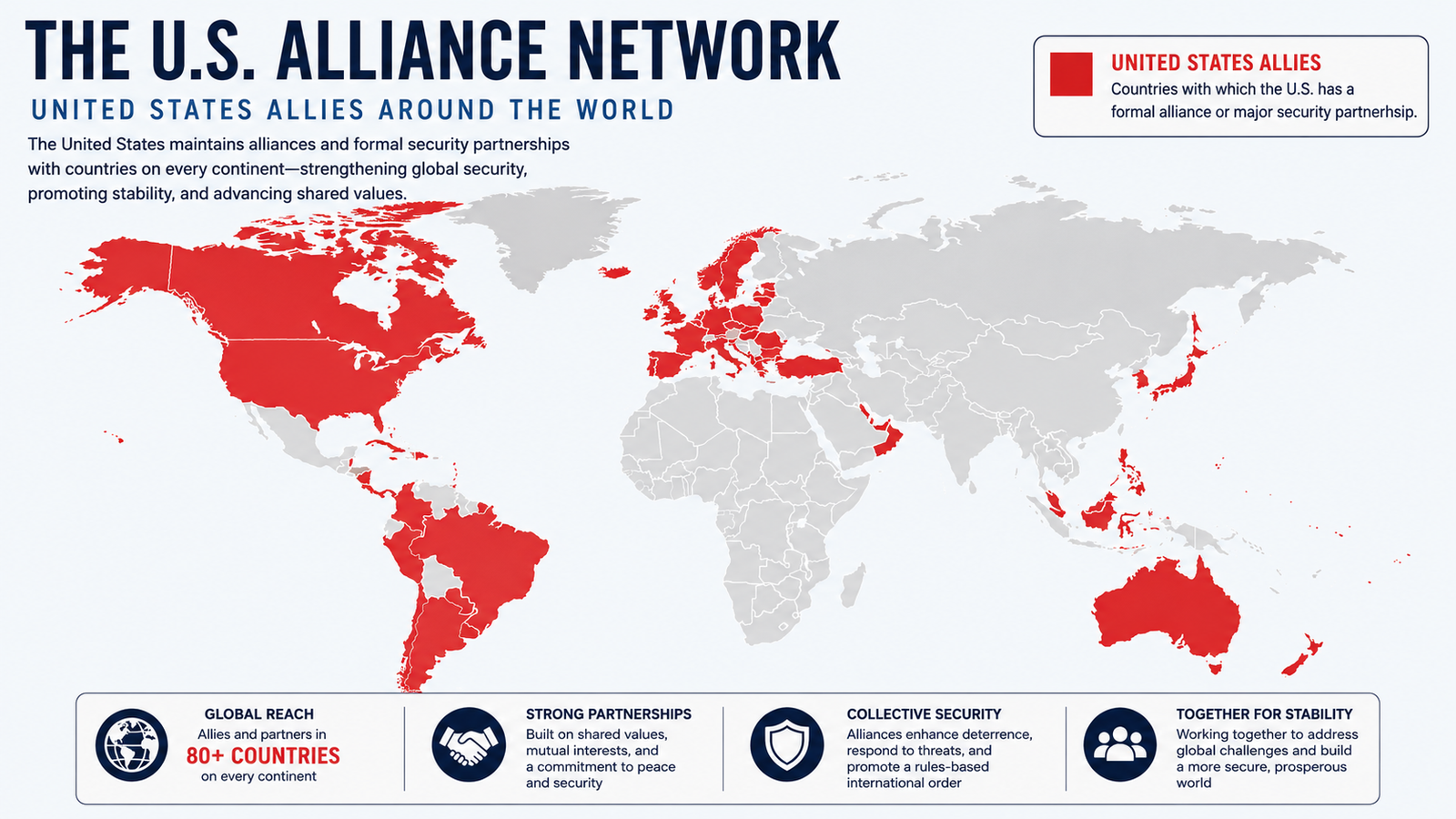
Ports.
Airfields.
Intelligence.
Industrial capacity.
Military forces.
Technology.
Logistics.
Political legitimacy.
Japan sits alongside the maritime approaches China would need to traverse to project power deeply into the Pacific.
Australia provides enormous strategic depth across the Indo-Pacific.
South Korea hosts major American forces adjacent to Northeast Asia.
European allies allow American forces to operate thousands of miles closer to potential crises than would otherwise be possible.
NATO combines North American power with European geography and economic capacity.
No competitor has assembled anything comparable.
Russia has relationships.
China has partnerships.
The United States has spent nearly eighty years building an institutionalized network of alliances linking many of the richest, most technologically advanced and militarily capable societies on Earth.
Those alliances are frequently contentious.
Europeans argue with Americans.
Americans complain about burden-sharing.
Japanese, Korean and American interests do not always align perfectly.
None of that invalidates the system.
The remarkable thing is that the system exists at all.
Great powers historically spent enormous effort preventing other great powers from combining against them.
The United States accomplished something unusual after World War II.
It persuaded many of the world’s most powerful countries that American power was not merely something to tolerate.
It was something worth institutionalizing.
The Next American Century
None of this means the twenty-first century will resemble the twentieth.
The United States faces serious problems.
Federal debt is rising at an unsustainable long-term trajectory.
Political polarization makes strategic planning increasingly difficult.
Infrastructure and industrial capacity require renewed investment.
Shipbuilding has declined dramatically from earlier generations.
Defense procurement is frequently slow and expensive.
Housing, education and healthcare costs place increasing pressure on American families.
China has become a genuine technological and military competitor.
Artificial intelligence could rearrange economic power in ways that are difficult to predict.
Demographic trends will challenge many developed countries, including the United States.
And the international system itself is becoming more competitive.
The period following the collapse of the Soviet Union was historically unusual.
For roughly two decades, the United States existed without a peer competitor.
That world is disappearing.
But the disappearance of uncontested American dominance does not necessarily imply the disappearance of American preeminence.
There is an important difference.
The twentieth century demonstrated what happened when America’s underlying advantages were fully mobilized.
In 1900, the United States was already an industrial giant, but European empires still dominated much of the international system.
By 1945, much of Europe and Asia lay devastated by war while the continental United States remained intact.
American factories had produced ships, aircraft, vehicles and weapons on a scale its enemies could not match.
American farms fed its own population and much of the Allied war effort.
American capital helped rebuild Europe and Japan.
American universities and laboratories became centers of global scientific research.
American institutions helped create the international financial and security architecture that followed.
By the end of the Cold War, the United States occupied a position of global power without close historical precedent.
The twenty-first century will be different.
America is no longer rising into an empty field.
It faces competitors that understand the sources of American power and actively seek to reproduce or undermine them.
China is building universities.
It is investing in artificial intelligence.
It is expanding its navy.
It is developing semiconductor industries.
It is securing energy supplies and commercial relationships around the world.
The appropriate American response is therefore not complacency.
It is recognition.
The United States should understand what actually made it powerful.
Not slogans.
Not any single president.
Not military spending alone.
The foundation is a system.
Geography created cheap transportation, agricultural abundance and continental security.
Those advantages helped capital accumulate.
Deep capital markets financed new industries.
Universities produced discoveries and talent.
Entrepreneurs combined that talent with capital to build transformational companies.
Technology and finance unlocked enormous domestic energy resources.
Economic strength financed unparalleled military capabilities.
And American diplomacy connected that military and economic power to an alliance network spanning much of the developed world.
Every layer reinforces the others.
That is why replacing the United States is so much more difficult than surpassing it in GDP, shipbuilding, steel production or any other individual metric.
A challenger does not merely need a larger economy.
It must reproduce an ecosystem.
America’s greatest danger, therefore, may not be that another country inevitably overtakes it.
It may be that Americans cease to understand the system they inherited and allow its individual components to decay.
The universities can deteriorate.
Capital can be misallocated.
Debt can become destabilizing.
Industrial capacity can disappear.
Alliances can fracture.
Innovation can be suffocated.
Military advantages can erode.
None of America’s advantages are permanent simply because they existed in the past.
But neither should they be dismissed because the world has become more competitive.
The United States enters the middle decades of the twenty-first century with extraordinary problems.
It also enters them with advantages that no other nation has yet assembled in combination:
An extraordinarily favorable geography.
Continental-scale agriculture and natural resources.
The world’s deepest financial markets.
A remarkable university and research system.
An entrepreneurial culture capable of turning research into companies.
Vast energy resources.
A military built for global power projection.
And an alliance network extending across both the Atlantic and Pacific.
The twentieth century became the American Century because the United States learned to turn those advantages into national power.
The question facing Americans today is not whether those advantages still exist.
They do.
The question is whether the country still possesses the discipline to use them.
If it does, the American Century may have considerably further to run.