
There is an old maxim that I am sure you have come across:
Never underestimate your enemy.
History is filled with the consequences of nations and leaders that failed to heed this simple warning.
The Romans learned this lesson from Carthage in 216 BC. Hitler learned this lesson two-thousand years later when he attacked the Soviet Union.
The United States committed a similar error in Vietnam.
Different centuries. Different adversaries. The same fundamental mistake.
And I believe the United States risks making another.
For much of the twenty-first century, Americans have watched the extraordinary emergence of China as a global superpower. Its economic influence now extends to virtually every corner of the planet. Its industrial capacity exceeds that of the United States by a margin of almost two-to-one. Its military has undergone a transformation that would have been almost unimaginable thirty years ago.
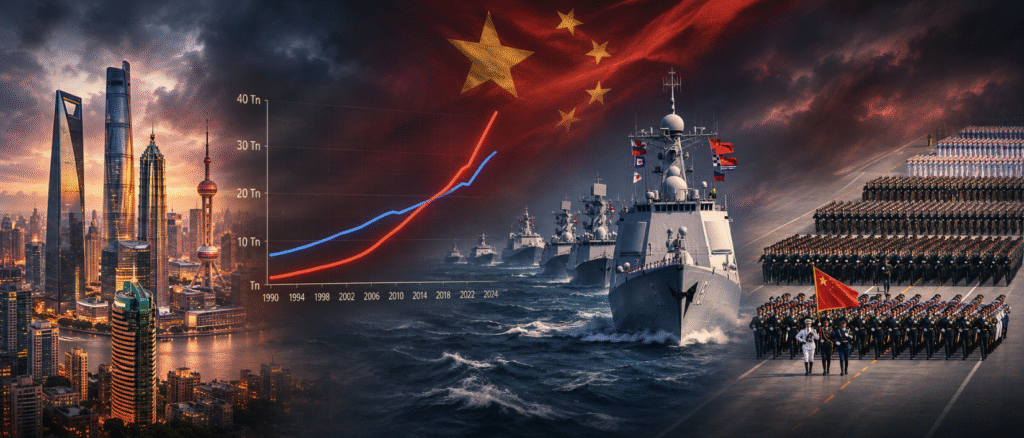
Chinese missiles threaten American military installations, while an increasingly sophisticated navy challenges decades of American maritime dominance in the Western Pacific. Its ambitions range from stealth fighters to modern nuclear carriers to advanced cyber operations.
A military confrontation between the United States and China would be unlike anything Americans have experienced in generations.
These are not the capabilities of a paper tiger, and I want to make one fact abundantly clear:
China is a formidable adversary, and Americans would be foolish to pretend otherwise.
But let’s take a step back and consider the bigger picture.
For all its military might, industrial strength, and economic influence, I am considerably less convinced by the prevailing narrative that China is destined to overtake the United States.
In fact, I suspect the greatest danger may come from something entirely different.
First, a little history lesson.
The Chinese Miracle
China’s emergence as an economic and industrial superpower over the past thirty years has been nothing less than remarkable. Again, I would be negligent to pretend otherwise.
Under the economic reforms of Deng Xiaoping, the PRC underwent one of the most extraordinary economic transformations in modern history.
Consider the magnitude of these achievements.
In 1990, China accounted for less than three percent of global manufacturing production. By 2026, that figure had climbed to approximately one-third. China now operates the world’s largest high-speed railway network, dominates the global shipbuilding industry (by a wide margin), and candidly leads the world in the production and research of advanced batteries, electric vehicles, telecommunications, and renewable energy.
I can confidently tell you that China seeks to become the world leader in advanced robotics, fusion power, artificial intelligence, quantum computing, etc.
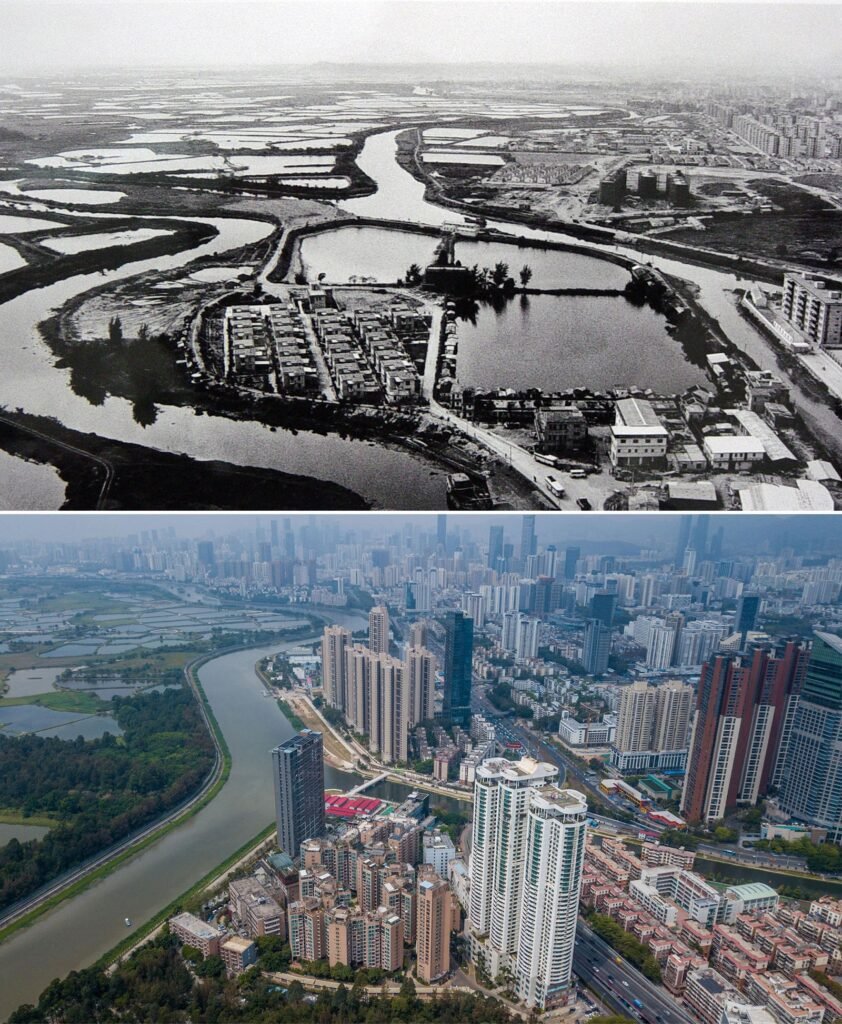
I want you to take a moment and think about that.
China is, by any reasonable measure, a genuine superpower competitor. (There, I said it—feel free to bookmark this one!)
But acknowledging what China has accomplished is not the same as accepting that its trajectory will continue indefinitely.
History offers remarkably few examples of economic expansion proceeding in a straight line. The conditions that generate extraordinary growth in one generation frequently become obstacles to sustaining it in the next.
China now confronts a collection of structural challenges that could fundamentally alter its long-term strategic position.
And that is the bigger picture I want us to consider.
Cracks in the Foundation
Perhaps the most consequential challenge facing China is one that cannot be resolved by constructing another railway, building another carrier, or issuing another five-year economic plan.
First, let’s discuss the elephant in the room…its population is shrinking.
And we aren’t talking about population stagnation or the loss of few hundred thousand people.
China is facing the largest demographic collapse in recorded history, and it is taking place right now, as you read this.
In 2025, China’s population declined by 3.39 million people. There were about 7.9 million babies born and 11.3 million people died.
(This is also the official narrative, I suspect the truth is much harsher.)
That number is expected to increase in the coming years. These figures are particularly troubling when considered alongside the legacy of China’s former one-child policy and decades of declining fertility.
Take a moment to consider China’s population pyramid below.
You may recall that a population pyramid has a broad base of younger generations supporting progressively smaller generations of older citizens. Healthy, developed societies tend to look more like columns.
China’s population looks fundamentally different.
This isn’t a pyramid. It’s a funnel.
And that narrowing base represents an enormous economic and demographic challenge for the decades ahead.

To put this in plain words: This is bad. Very bad.
An aging population without a younger population to fill the ranks carries massive economic consequences.
The labor force contracts. Retirees increase. Excess credit and capital dry up. Fewer people are ultimately productive.
For an economy that built much of its prosperity upon abundant labor and rapid industrial expansion, that represents a formidable structural challenge.
Of course, demographics are not destiny. Automation, improvements in productivity, and technological innovation can partially offset a declining workforce.
But there are limits to what technology can accomplish. Technology, robots, computers, machines are very expensive to build and China has been running into banking and credit issues for a long time.
Second, China is no longer the low-cost manufacturing center it was twenty years ago.
For decades, China’s economic miracle rested partly upon a remarkably simple proposition: why manufacture something in the United States when you could produce it in China for a fraction of the cost?
And for American corporations, the economics were often difficult to ignore.
But there’s an irony to China’s extraordinary success. As the country became wealthier, its workers understandably demanded higher wages. Living standards improved, a middle class emerged, and the inexpensive labor that once made China the world’s factory became considerably less inexpensive.
Today, manufacturers increasingly look toward Vietnam, India, Mexico, and other emerging economies for lower labor costs, supply-chain diversification, and reduced exposure to geopolitical tensions.
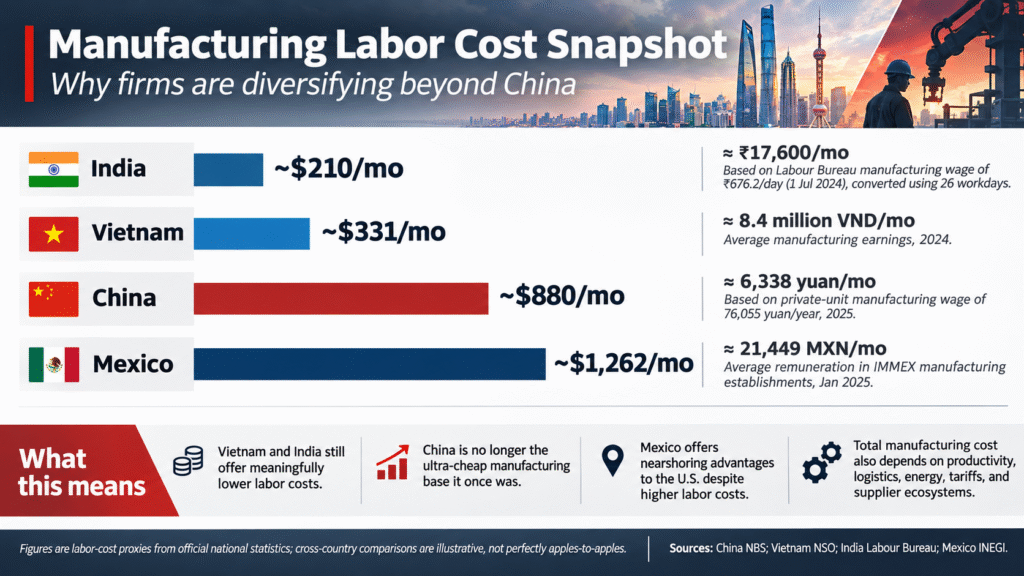
And when you consider the added cost of transportation, tariffs, and legal aspects of doing business closer to home, the economics become much less favorable to China.
Then factor in the declining population covered above and you get a cumulative effect. Stated simply, it becomes more expensive each day to hire and outsource to China.
China still possesses enormous advantages in infrastructure, skilled labor, and industrial scale. But one of the great engines of its economic ascent—an abundant supply of exceptionally inexpensive workers—is gradually losing its competitive edge.
Put simply, China is discovering that becoming wealthy makes it considerably harder to compete on being cheap.
Then there is the uncomfortable matter of debt.
For decades, China fueled its extraordinary expansion through massive investments in property development, infrastructure, and industrial capacity. The results were often spectacular. Unfortunately, so was the borrowing required to finance them.
Today, local governments and their financing vehicles carry enormous debt obligations, while China’s increasingly investment-dependent economy struggles to generate the same returns it once enjoyed.
Building another railway station is relatively straightforward. Generating enough economic activity to justify its construction is an entirely different matter.
And Fourth, let’s examine the long-term trajectory of their economy.
For much of the past four decades, China’s economic rise seemed almost unstoppable. Double-digit growth became commonplace, gleaming cities emerged seemingly overnight, and an entire generation of economists and geopolitical analysts confidently predicted that China would eventually eclipse the United States. There was an almost euphoric certainty about it. China’s ascendancy wasn’t treated as a possibility, but as an inevitability.
Funny how much quieter that conversation has become.
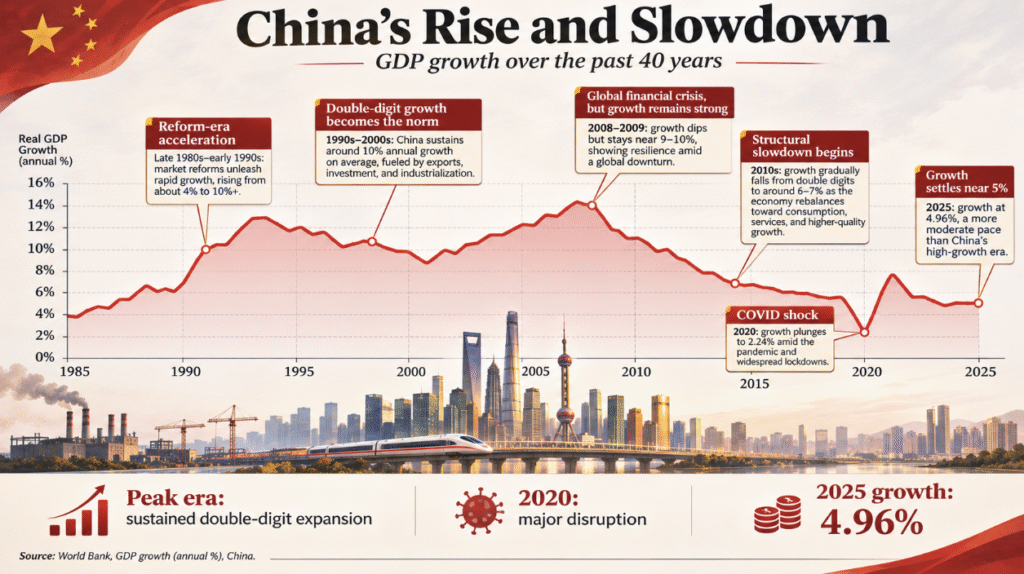
After decades of extraordinary expansion, China’s economic growth has slowed considerably, from the double-digit rates of its boom years to roughly five percent today. The world’s second-largest economy remains formidable, but the narrative has changed. Where analysts once debated when China would overtake America, they increasingly debate whether its economic model can sustain the ambitions of its leadership.
The Chinese miracle was real. The assumption that it would continue indefinitely was considerably less certain.
Now I also want to make one thing clear: None of this suggests that the Chinese economy is on the verge of imminent collapse.
China retains enormous productive capacity. They still have substantial financial resources. Their infrastructure is world class. And candidly, I think the country is filled with great people and I do believe there will be some additional growth in the near term.
But the distinction between growth and sustained geopolitical ascent is an important one.
An economy can continue expanding while its underlying advantages diminish.
None of these challenges renders China economically irrelevant. Far from it.
Can a political and economic system that proved extraordinarily effective at mobilizing resources for industrial expansion demonstrate the same effectiveness when confronted with the more complicated demands of an aging, technologically advanced, consumption-driven economy?
Perhaps.
But I would not assume that the answer is yes.
Where China Concerns Me.
This brings us to what I consider the most concerning dimension of China’s strategic position.
For decades, Chinese leaders could reasonably assume that time was working in their favor.
Their economy was expanding rapidly. Their military capabilities were improving. Their industrial influence was growing. And with each passing year, the gap between Chinese and American power appeared to narrow.
Under those circumstances, patience was a rational strategy.
But time is now up.
Its population is aging and contracting. Economic growth is moderating. The property sector remains troubled. International trading relationships are becoming more contentious. And the United States, despite its own considerable difficulties, retains an extensive network of allies, enormous technological capabilities, and significant economic advantages in GDP, capital accumulation and R&D.
Here’s the Problem.
The Chinese leadership may eventually conclude that its relative strategic position is approaching a peak.
That conclusion would carry particularly significant implications for Taiwan, the rest of Asia, and ultimately the world.
Suppose China’s leadership comes to believe that its economic and military position will be less favorable in 2040 than it is in 2030.
Suppose it concludes that American alliances in the Pacific are becoming stronger, Taiwan’s defensive capabilities are improving, and the possibility of achieving unification through political pressure is diminishing.
Under those circumstances, delay may no longer appear prudent.
It may begin to look like strategic surrender.
And that combination creates the potential for profoundly dangerous strategic calculations.
This does not mean that China has decided to invade Taiwan, or that a military confrontation is inevitable.
In fact, the United States intelligence community’s 2026 Annual Threat Assessment concluded that Chinese leaders did not have a fixed timeline for unification and were not then planning an invasion in 2027.
Nor should we discount the possibility that China’s economic challenges could encourage restraint. A leadership concerned about domestic stability might reasonably conclude that a disastrous war would only accelerate the problems it hopes to overcome.
But there is another possibility.
A leadership that increasingly believes its strategic opportunity is disappearing may become willing to accept risks that would have appeared unacceptable only a decade earlier.
The danger is not necessarily that China believes it is becoming unstoppable. The danger is that Beijing may eventually conclude it is running out of time.
The Danger of a Powerful but Anxious Adversary
There is a tendency in geopolitical commentary to treat national power as though it rises and falls in direct proportion to economic performance.
This is a mistake. A big one.
A slowing economy does not cause military forces to disappear. Demographic decline does not render ballistic missiles inoperable. And political instability does not automatically eliminate a nation’s willingness or ability to wage war.
China will remain an extraordinarily formidable military power even if its economic expansion slows considerably.
Its naval forces possess a growing inventory of modern surface combatants and submarines. Its missile forces can threaten American installations, naval formations, and allied military infrastructure across much of the western Pacific.
China also possesses sophisticated cyber capabilities, substantial space-based military infrastructure, and a defense-industrial base capable of producing weapons and equipment on an enormous scale.
And let’s not forget, its expanding nuclear arsenal complicates any confrontation between Washington and Beijing.
These capabilities should not be underestimated.
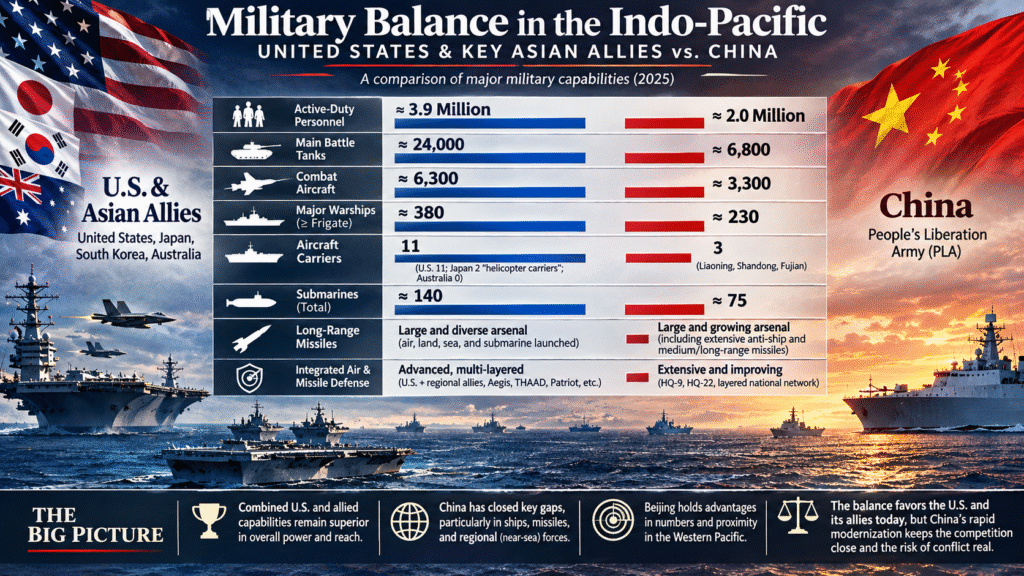
The appropriate American response is neither panic nor complacency. The United States retains extraordinary economic, technological, and military advantages, particularly when combined with those of its allies. But maintaining those advantages requires credible deterrence, sufficient industrial capacity, and diplomatic channels capable of preventing strategic competition from becoming military confrontation. A confident America should be prepared to compete with China without convincing Beijing that war is inevitable.
An American military confrontation with China would be profoundly different from the conflicts the United States fought in Iraq and Afghanistan.
American aircraft carriers and forward operating bases would face serious threats. Communications and satellite networks could be disrupted. Critical infrastructure might be targeted through cyber operations. Supply lines stretching across the Pacific would become increasingly vulnerable.
And both nations would confront the terrible possibility of escalation between nuclear-armed powers.
The Question That Should Concern Us
For much of the twenty-first century, Americans have been encouraged to contemplate a future in which an increasingly powerful China gradually eclipses the United States.
I am considerably less convinced that this outcome is inevitable.
China’s economic transformation has been extraordinary, but the structural challenges it now confronts are substantial. Its demographic trajectory is unfavorable. Its economic model requires difficult adjustments. And its political system may struggle to reconcile centralized authority with the flexibility necessary to navigate an increasingly complicated international environment.
None of this means that China is destined to fail.
Nor does it mean that the United States can afford complacency.
My concern is something rather different.
What happens when a rising power begins to suspect that its best days may already be behind it?
History offers an uncomfortable possibility.
Nations do not always go to war because they are confident of victory. Sometimes they go to war because they fear that the opportunity for victory is slipping away.
And that, far more than the prospect of Chinese global supremacy, is what concerns me.
When Geopolitical Rivalry Becomes Global Conflict
I explore many of these same strategic tensions in The Eagle & The Dragon, my military thriller series examining how a confrontation between the United States, China, and their allies could escalate into a devastating global war.
If you enjoy realistic military fiction grounded in contemporary geopolitics, I invite you to explore the series.
Discover The Eagle & The Dragon Series
About the Author
John Webber is a graduate of Harvard University and The Citadel, The Military College of South Carolina. A seasoned strategist with two decades of experience in global banking, finance, and military affairs, he brings real-world insight into the complex forces that drive nations, markets, and conflict.

Drawing on his background in military and international finance, John writes at the crossroads of military power, geopolitics, and global finance—exploring how navies guard sea lanes, how credit feeds the world’s economy, and how geopolitics, technology, and conflict shape national strategy.
Discover more of his work at MilitaryThrillers.com and follow him on X / Twitter at @WebberGeo.
Sources and Further Reading
- United Nations Industrial Development Organization — International Yearbook of Industrial Statistics 2025
- National Bureau of Statistics of China — 2025 National Economic and Social Development
- International Monetary Fund — 2025 Article IV Consultation with China, published February 2026
- International Energy Agency — Global EV Outlook 2026
- U.S. Office of the Director of National Intelligence — 2026 Annual Threat Assessment
- U.S. Department of Defense — 2025 China Military Power Report