

China’s Greatest Threat Isn’t America. It’s the Calendar.
Beijing has spent decades preparing for a confrontation with the United States. But there is one adversary its military cannot defeat, its factories cannot outproduce, and its government cannot intimidate: time.
The Enemy Beijing Cannot Defeat
Somewhere in China, a factory manager is searching for workers who will never arrive. A property developer is staring across an unfinished residential complex, wondering where the families are who were supposed to occupy it. A provincial official is reviewing pension obligations that continue to grow, even as the number of people entering the workforce begins to shrink.
And inside the halls of Zhongnanhai, China’s leadership is confronting a problem that no amount of military spending, industrial subsidies, or political coercion can easily solve.
This is a view into China in the not so distant future.
The Chinese population is dying faster than it is reproducing.

In 2025, approximately 7.9 million children were born in China. More than 11.3 million people died. The country lost nearly 3.4 million people to natural population decline in a single year.
This trend is only expected to continue and the implications are enormous.
A nation that spent four decades constructing the world’s most formidable manufacturing economy is now watching the demographic foundation beneath that economy collapse.
And the timing could hardly be worse.
China is attempting to challenge American military supremacy in the Western Pacific, expand its influence across multiple areas of the globe, and transform its economy into a technology-driven superpower.
Yet its population is beginning a contraction that could continue for generations.
In my previous essay, Why China Doesn’t Scare Me. Its Desperation Does., I argued that the greatest danger posed by Beijing may not come from its increasing strength, but from its perception that its opportunity to challenge the American-led international order is beginning to close.
There is an uncomfortable question at the center of that argument.
What if China’s leaders already know that the country they govern today may be more capable of challenging the United States than the country they will govern twenty years from now?
To understand why that possibility matters, we must examine the extraordinary demographic circumstances that made China’s rise possible.
And what happens when those circumstances disappear.
The Demographic Machine That Built Modern China
China’s economic transformation is one of the most remarkable achievements in modern history.
In 1980, the country was overwhelmingly poor. Much of its population lived in rural communities, agricultural productivity remained relatively low, and Chinese industry lagged far behind its Western competitors.
Fast forward four decades and China had become the world’s largest manufacturing power, constructed infrastructure on a breathtaking scale, and lifted hundreds of millions of people out of extreme poverty.
Economic liberalization, foreign investment, technology transfers, and access to Western consumer markets all played important roles.
But beneath these developments stood another advantage.
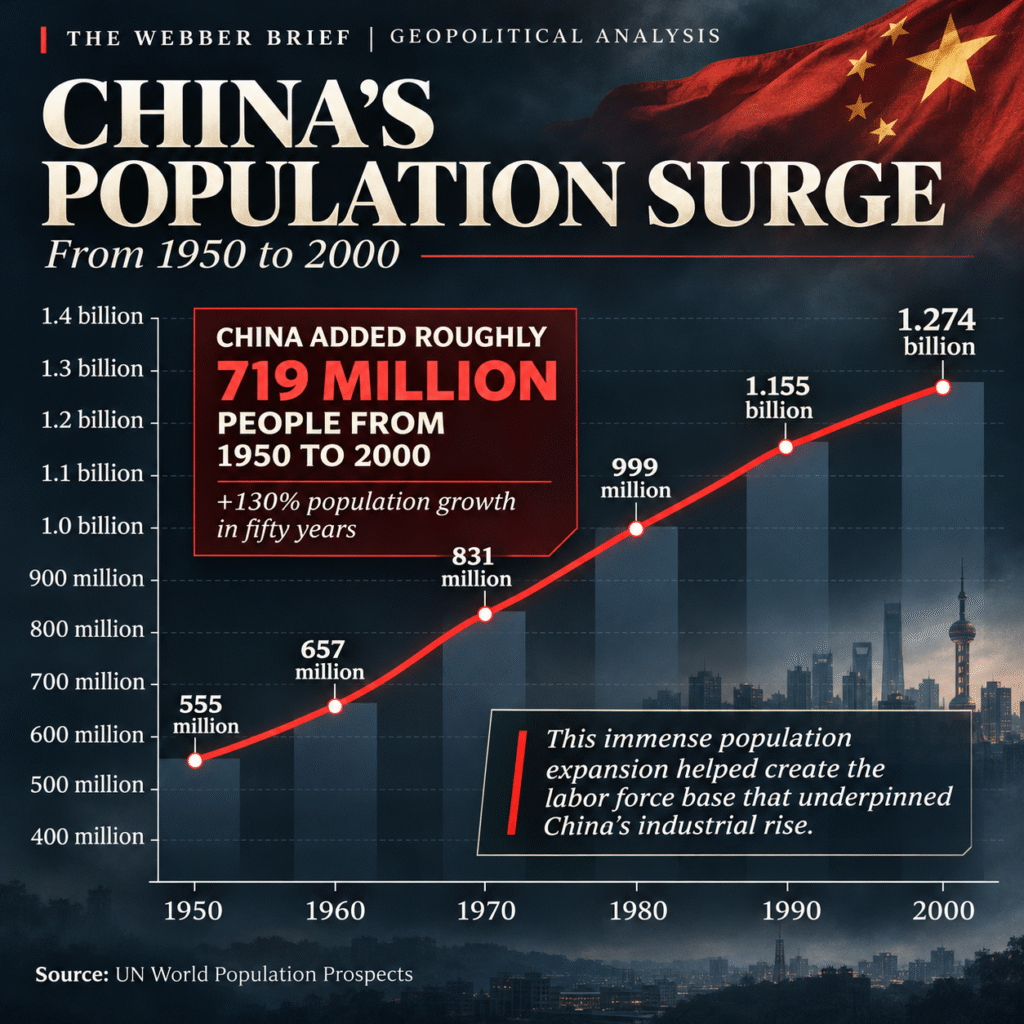
China possessed an enormous supply of working-age people at precisely the moment its economy began integrating with the world.
Economists call this a demographic dividend. And that dividend paid enormously.
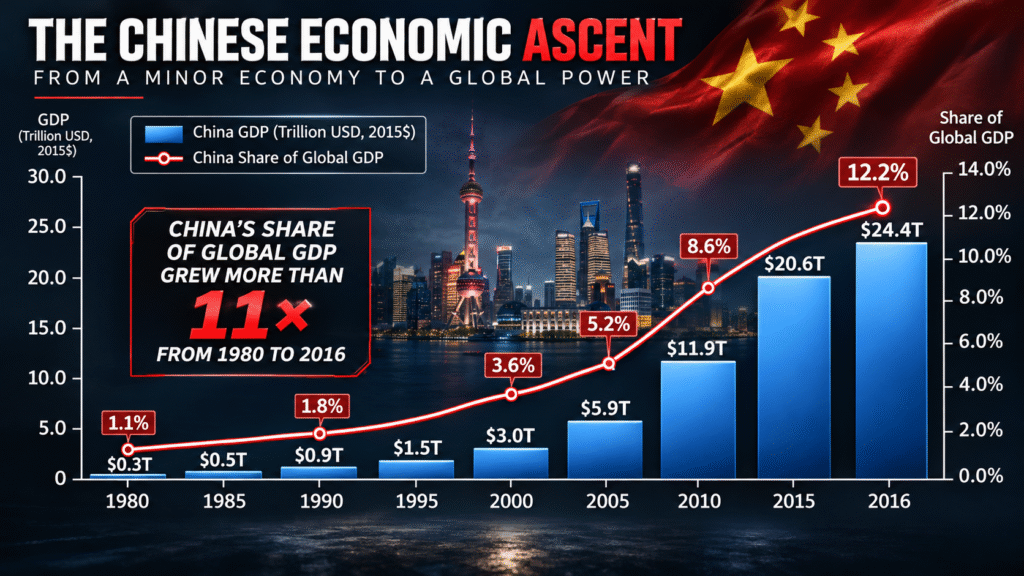
When a large proportion of a nation’s population is of working age, while relatively fewer people are children or elderly dependents, the economy enjoys an enormous structural advantage.
More people can work. More income can be generated. More capital can be saved and invested.
China had this advantage in abundance.
Beginning in the 1980s, hundreds of millions of Chinese citizens migrated from rural communities into rapidly expanding industrial cities.
Factories appeared along the eastern coastline. Manufacturing centers spread across Guangdong, Jiangsu, and Zhejiang. Cities like Shenzhen transformed from a fishing community to a technology hub rivaling San Francisco.
New ports. New highways. New skyscrapers. New high-speed rail networks.
The country’s vast labor supply helped Chinese manufacturers compete aggressively on price.
Meanwhile, growing employment and urbanization supported extraordinary demand for housing, infrastructure, and consumer goods.
Workers became consumers. Consumers became homeowners. Developers built entire neighborhoods to accommodate them.
The process reinforced itself.
More workers generated more production. More production created more income. More income supported additional investment and capital generation.
China’s demographic dividend did not single-handedly create its economic miracle, but it amplified almost every other advantage the country possessed.
For decades, the population structure helped propel China forward.
Today, that same structure is becoming an economic liability.
The Population Pyramid Is Turning Upside Down
There is a particularly useful way to visualize a nation’s demographic future.
It is called a population pyramid.
Divide a country’s population by age and sex, placing younger generations at the bottom and older generations at the top.
A traditional pyramid has a broad base, representing large younger generations, and a narrow summit, representing fewer elderly citizens.
But when the base begins narrowing while the upper portion expands, something fundamentally different is taking place.
The population is aging.
Eventually, absent sufficient births or immigration, it begins to shrink.
China is now moving decisively in that direction.
2000: The Foundation of a Superpower
Look at China’s population pyramid in 2000.
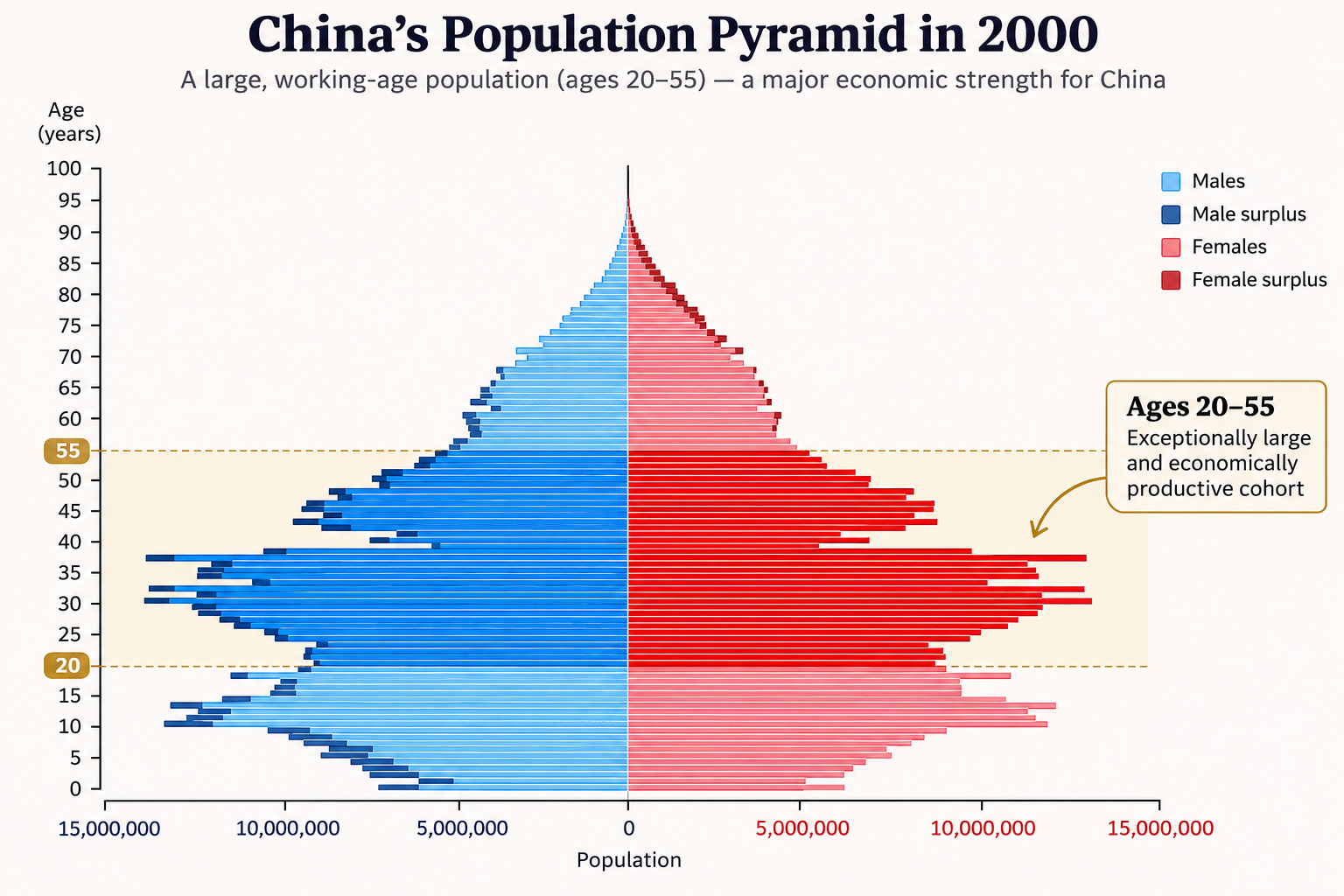
Large generations of young adults were preparing to enter the workforce already rich with working age adults in the middle of their most economically productive years of their lives.
These cohorts would help power China’s industrial expansion for decades.
By the time China joined the World Trade Organization in 2001, much of this demographic momentum was already in motion.
But the pyramid also concealed the consequences of decisions made years earlier.
China’s one-child policy, introduced nationally around 1980, accelerated an existing decline in fertility.
Initially, the economic consequences appeared favorable. Fewer children meant fewer young dependents, while enormous earlier generations entered their most productive years.
China was collecting its demographic dividend.
But every dividend eventually comes due.
2025: The Great Inversion Begins
Fast-forward to today.
China’s population pyramid no longer resembles the structure that helped power its industrial ascent.
Consider what the population will look like in a few short years and pay particular attention to cohort of younger Chinese citizens in the the lower portion of the graph.
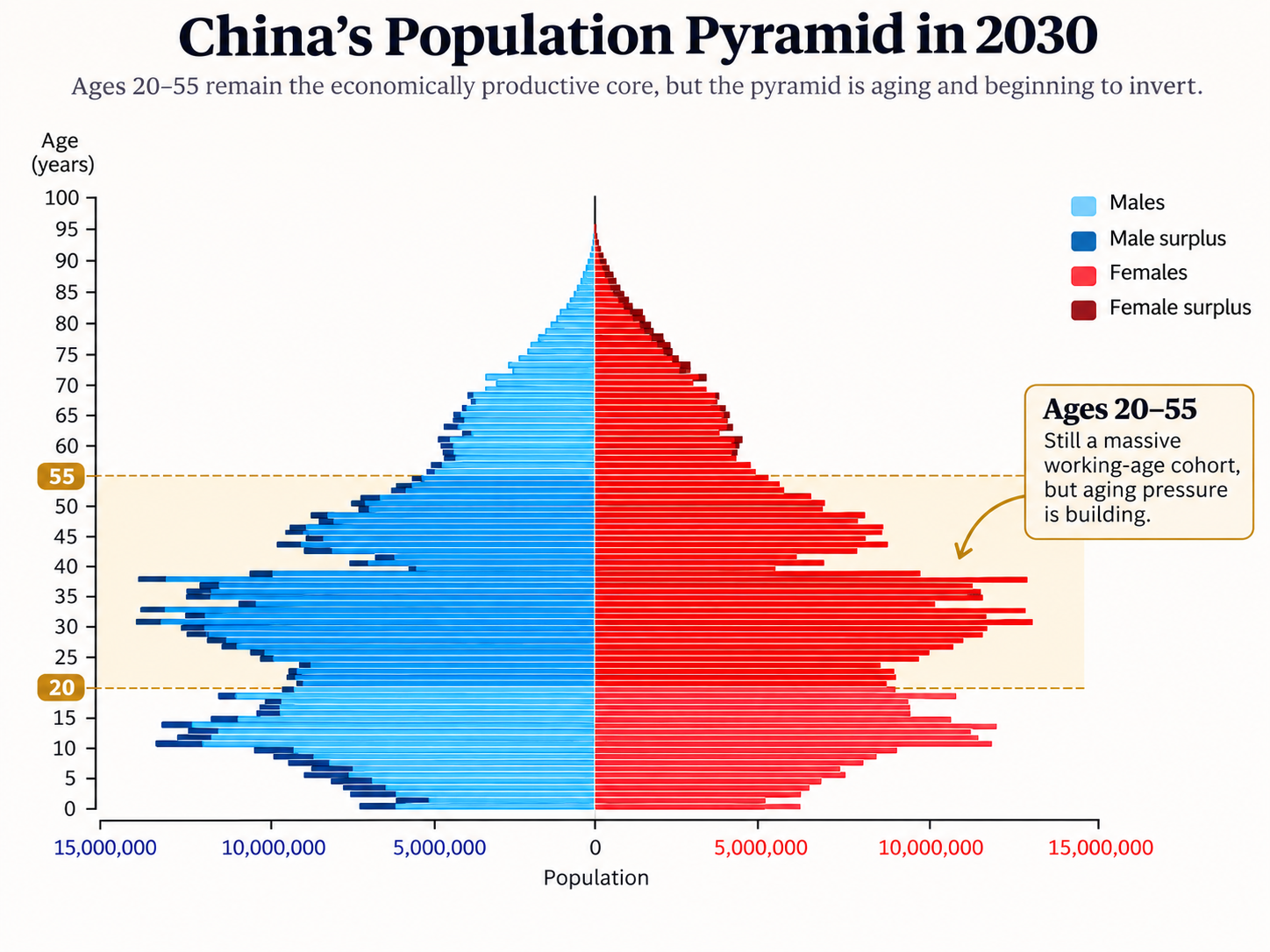
The younger generations are substantially smaller relative to many middle-aged cohorts. Decades of declining fertility have narrowed the base.
Meanwhile, the elderly population continues expanding.
By the end of 2025, approximately 323 million Chinese citizens were aged 60 or older, representing roughly 23 percent of the population.
Nearly one in four.
The consequences are already emerging. Fewer young workers are available to replace retiring generations. Household formation faces increasing demographic pressure. Pension and healthcare obligations are expanding.
And there is another complication.
China’s Missing Women
China has a significant imbalance between men and women.
Its 2025 population survey recorded approximately 717 million men and 688 million women, a difference of nearly 29 million.
Decades of traditional preferences for sons, restrictive family-planning policies, and sex-selective births helped create unusually large male cohorts.
The national imbalance does not mean there are 29 million marriage-age men without potential partners. Age differences and women’s longer life expectancy complicate that comparison somewhat.
Nevertheless, the imbalance is particularly consequential among younger and middle-aged generations.
In some regions, especially poorer rural communities, men already face substantial difficulties finding potential spouses.
For a government attempting to encourage marriage and reverse declining fertility, that represents another structural obstacle.
But the most alarming implications emerge when we look forward.
2050–2100: A Nation Growing Old
According to the United Nations’ medium population projection, China’s population could fall to approximately 1.26 billion by 2050. That’s a lose of nearly 150 million people.
By 2100, that figure could decline to roughly 633 million. Less than half the number of people living in the country today.
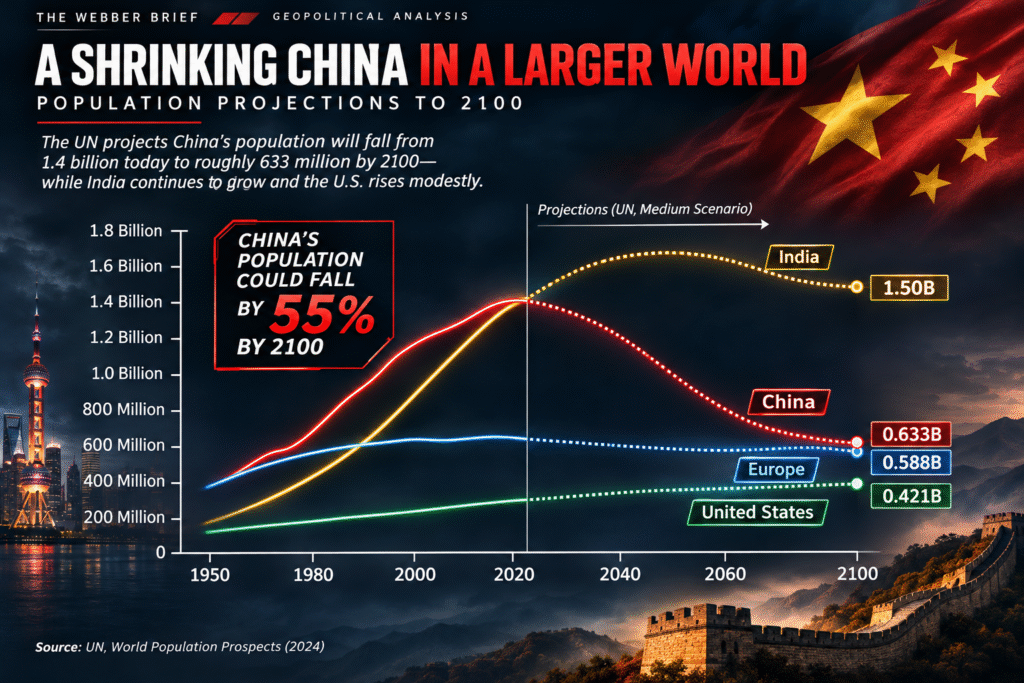
Long-range demographic forecasts are uncertain. Fertility, migration, life expectancy, and government policy can all change.
But the near-term demographic trajectory is far more predictable.
Most of the people who will comprise China’s workforce in 2040 have already been born.
So have the generations who will enter retirement.
This creates a problem no government can quickly reverse.
A child not born today cannot enter the workforce twenty years from now.
There is no economic stimulus package capable of immediately replacing a missing generation.
China spent forty years constructing an economy around an expanding workforce. It must now sustain that economy with a contracting one.
Japan: A Warning From the Future
China is not the first industrial power to confront demographic decline.
Japan provides a revealing example.
During the decades following World War II, Japan emerged as one of the world’s great economic success stories.
Its automotive, electronics, and manufacturing companies became global leaders. By the late 1980s, American policymakers openly worried about Japan’s economic ascendancy.
Then the environment changed.
Japan’s asset-price bubble collapsed in the early 1990s, producing prolonged financial and economic difficulties.
But another structural transformation was unfolding.
Japan was also aging.
Its working-age population peaked at approximately 87 million in 1995. By 2024, it had declined to roughly 74 million.

The consequences have been substantial.
Labor shortages have intensified. Pension and healthcare expenditures have grown. Rural communities have experienced depopulation, and millions of homes across the country sit vacant.
Japan has responded through automation, increased labor-force participation, and other adaptations.
Yet its experience illustrates how an inverted population pyramid can constrain national economic performance.
To be clear, Japan’s economic stagnation cannot be attributed exclusively to aging. Financial crises, policy decisions, and productivity challenges were also important.
Nor has Japan collapsed. It remains a wealthy, technologically advanced, and remarkably stable society.
But there is a critical distinction between Japan’s experience and China’s future.
Japan became rich before it became old. China is growing old before becoming comparably rich.
Japan entered its demographic transition with high household wealth, sophisticated institutions, and advanced public services.
China remains substantially poorer on a per-person basis, with considerable inequality between prosperous coastal cities and less-developed inland regions.
Beijing must now finance an aging society while attempting to raise living standards, sustain industrial competitiveness, and modernize its military.
Japan offers a glimpse of the future.
China’s circumstances could prove considerably more difficult.
The Economic Consequences Beijing Cannot Ignore
The demographic crisis threatens several pillars of China’s economic model.
First, the workforce.
For decades, abundant labor helped make China the world’s factory.
As its working-age population contracts, manufacturers must maintain production with fewer available workers.
China is investing heavily in robotics, artificial intelligence, and advanced automation. These technologies could substantially offset labor shortages through higher productivity.
But technology does not solve every consequence of demographic decline.
A robot can manufacture an automobile.
It cannot independently replace the household spending, family formation, or tax contributions associated with a missing generation.
Second, the property market.
China’s extraordinary construction boom depended heavily on urbanization and household formation.
Developers financed entire communities in anticipation of future demand. Local governments relied heavily on revenues associated with property development and land-use rights.
But what happens when the generations entering adulthood become progressively smaller?
Housing demand will not disappear. Urban migration and changing household preferences will continue creating opportunities.
Nevertheless, sustained population decline creates a formidable obstacle for an economy already struggling with property-sector imbalances.
Third, domestic consumption.
Beijing has spent years attempting to rebalance its economy toward household spending.
But smaller younger generations mean fewer potential first-time homebuyers, parents, and consumers of many durable goods.
An aging population also tends to devote a different share of spending toward healthcare and retirement needs.
China can become wealthier even with fewer people. Higher incomes and productivity could support continued consumption growth.
But achieving that transformation becomes more difficult when household finances are increasingly burdened by the costs of aging.
Finally, there is the question of who pays.
A growing elderly population requires pensions, healthcare, and long-term care.
A smaller working-age population must generate the economic resources to support those obligations.
Beijing can raise retirement ages, reform pension systems, increase productivity, and redirect public spending.
It has already begun implementing some of these measures, but each carries political and economic consequences.
China can construct another aircraft carrier. It can subsidize enormous semiconductor factories. It can finance another high-speed railway.
It cannot order an entire generation into existence.
The Most Dangerous Consequence Is Geopolitical
This brings us to the question that matters most.
What does China’s demographic future mean for the balance of power between Beijing and Washington?
One interpretation is reassuring.
As China ages, slower workforce growth and expanding social obligations may gradually constrain its ability to sustain the economic and military resources necessary to challenge American predominance.
A leadership confronting demographic decline may become more cautious about risking a costly international confrontation.
That is entirely possible.
But there is another interpretation.
What if demographic decline makes China more dangerous before it makes China less powerful?
China’s military has undergone an extraordinary transformation.
Its navy has expanded dramatically. Its missile forces have become increasingly sophisticated. Its defense industry possesses enormous manufacturing capacity.
Meanwhile, China has developed considerable technological capabilities in fields ranging from telecommunications and industrial robotics to batteries and artificial intelligence.
None of this disappears because the population begins to shrink.
China will remain a formidable military and economic power for decades.
Indeed, improvements in productivity could allow its capabilities to expand even as its population contracts.
But long-term demographic pressures may still influence Beijing’s strategic calculations.
Consider the problem from the perspective of China’s leadership.
The United States maintains a formidable network of alliances and security partnerships throughout the Western Pacific.
Japan is strengthening its defense capabilities. Australia is expanding military cooperation with Washington. The Philippines has become increasingly important to America’s regional posture.
Taiwan remains a central objective of Chinese national strategy.
Now introduce the possibility that China’s relative economic and demographic advantages may deteriorate over time.
The calculation changes.
If Chinese leaders believe their ability to achieve certain geopolitical objectives will be greater in 2030 than in 2050, might they become more willing to accept risks today?
This is not an argument that a Chinese invasion of Taiwan is inevitable.
Demographic decline does not automatically produce military aggression. Aging societies can become more risk-averse, particularly when war threatens economic stability and social welfare.
But history provides reasons to take perceptions of relative decline seriously.
Great powers do not always respond peacefully when their leaders believe their strategic position is deteriorating.
Sometimes, the fear of losing an advantage creates pressure to act before the opportunity disappears.
That is the danger.
Not that a shrinking China must become aggressive.
But that its leaders may convince themselves that the window for achieving their ambitions is closing.
The Clock Is Already Running
There is a tendency in the West to evaluate China’s future through annual GDP growth, military spending, industrial production, and technological competition.
These indicators matter.
But they tell us primarily how powerful China is today.
Demographics reveals something different.
It exposes structural forces that will shape Chinese power for generations.
And those forces are moving in a troubling direction.
China must now navigate a future in which fewer young people support larger generations of elderly citizens, while its economy attempts to sustain industrial competitiveness and expand household prosperity.
The challenge is not necessarily insurmountable.
Automation, productivity growth, and economic reform could mitigate much of the burden.
A smaller population does not automatically mean a weaker country.
But the demographic conditions that made China’s rise possible are disappearing.
And unlike a recession, a trade dispute, or even a technological disadvantage, an inverted population pyramid cannot be reversed within a few years.
Which brings us to a final, uncomfortable conclusion.
For decades, American strategists have asked what happens when China becomes powerful enough to challenge the United States.
Perhaps we have been asking the wrong question.
Perhaps the more consequential question is what happens when China’s leaders believe their country is approaching the height of its relative power.
The distinction is profound.
A rising nation confident in tomorrow may be willing to wait.
A nation fearing relative decline may perceive waiting as a strategic defeat.
China is not destined to collapse. Its factories will not suddenly fall silent. Its nuclear arsenal will remain formidable. Its technological capabilities will continue evolving.
But its demographic foundation is changing, and the consequences will become increasingly difficult to ignore.
Every year, another large generation moves closer to retirement.
Every year, smaller cohorts prepare to enter the workforce.
And every year that fertility remains exceptionally low, the challenge becomes harder to reverse.
The United States should not mistake these pressures for evidence that China is no longer dangerous.
It should recognize that those same pressures could influence Beijing’s decisions in unpredictable ways.
I do not believe China’s greatest threat to American power comes from its ability to sustain uninterrupted economic and military ascendance indefinitely.
I am far more concerned about the decisions its leaders could make if they come to believe that such ascendance is no longer possible.
Because the most dangerous moment in a great-power rivalry may not arrive when a challenger believes victory is inevitable.
It may arrive when that challenger begins to suspect its opportunity is slipping away.
China has spent decades preparing for a confrontation with America.
But there is another confrontation already underway.
And this time, Beijing is fighting the calendar.
When Geopolitical Rivalry Becomes Global Conflict
I explore many of these same strategic tensions in The Eagle & The Dragon, my military thriller series examining how a confrontation between the United States, China, and their allies could escalate into a devastating global war.
If you enjoy realistic military fiction grounded in contemporary geopolitics, I invite you to explore the series.

Discover The Eagle & The Dragon Series
About the Author
John Webber is a graduate of Harvard University and The Citadel, The Military College of South Carolina. A seasoned strategist with two decades of experience in global banking, finance, and military affairs, he brings real-world insight into the complex forces that drive nations, markets, and conflict.

Drawing on his background in military and international finance, John writes at the crossroads of military power, geopolitics, and global finance—exploring how navies guard sea lanes, how credit feeds the world’s economy, and how geopolitics, technology, and conflict shape national strategy.
Discover more of his work at MilitaryThrillers.com and follow him on X / Twitter at @WebberGeo.