

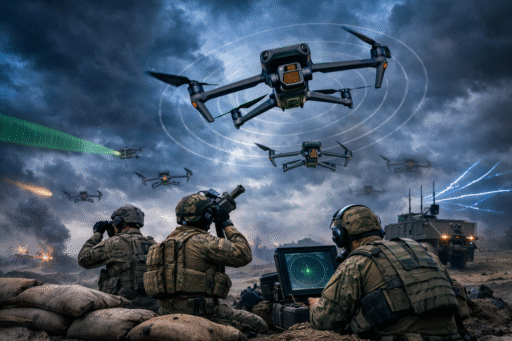
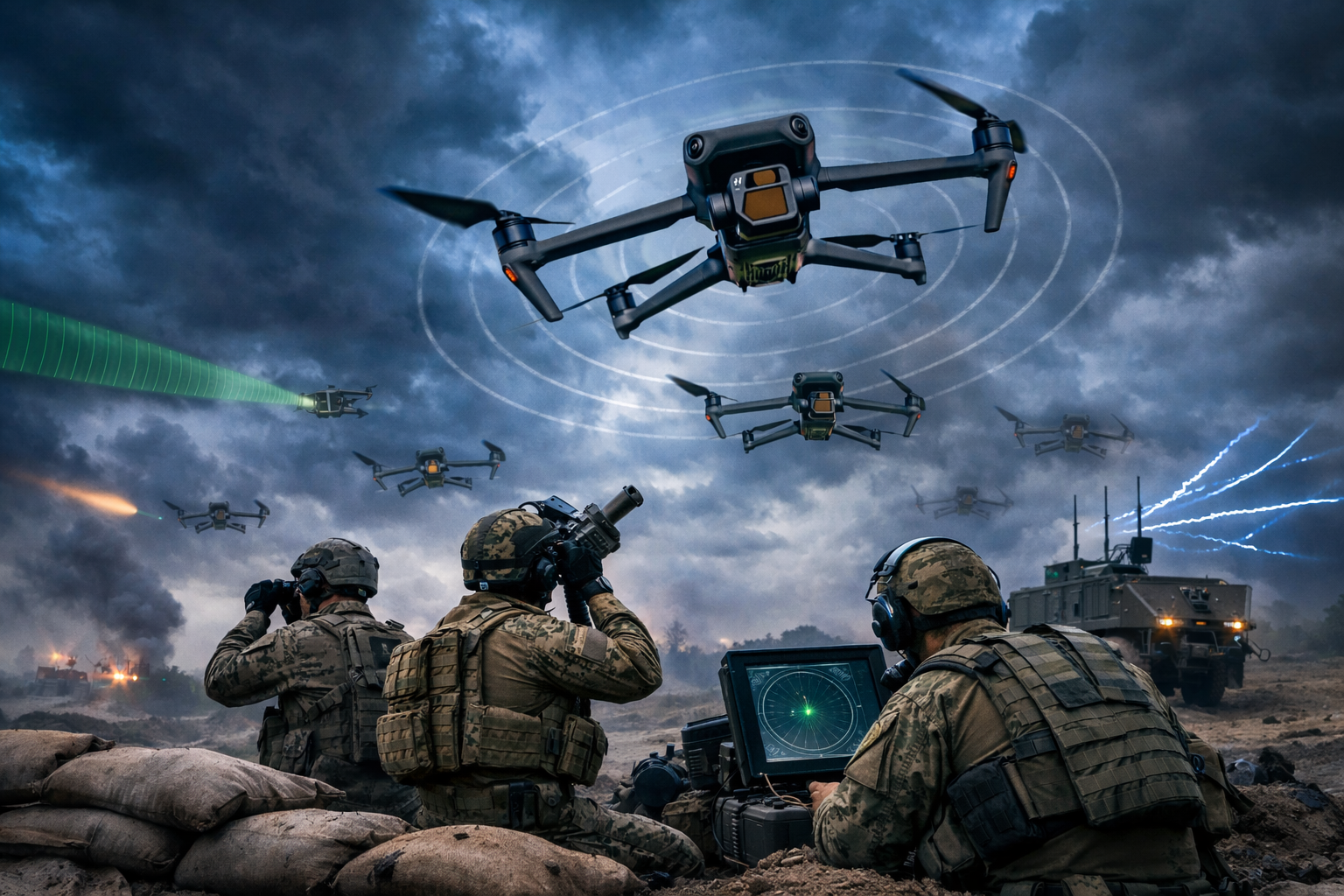
For most of the twentieth century, control of the skies was an expensive, limiting factor. Control the skies, and you control the battlespace. This capability was typically reserved for the best funded and equipped militaries of their respective era – the Germans of early World War II, the Soviets in Afghanistan, the Americans in Vietnam and the Gulf War.
Reconnaissance required aircraft, satellites, or specialized units operating deep behind enemy lines. Precision strike demanded fleets of jets, complex targeting systems, and the kind of logistical machinery only major powers could sustain. Information and lethality were expensive commodities, issued sparingly and controlled from the top.
That era is over.
Today, a squad-sized unit can launch its own eyes into the sky in minutes. A drone small enough to fit in a rucksack can hover silently above a treeline, relay live video, mark a target, and—if required—strike it. What once required a carrier air wing can now be improvised with batteries, code, and commercial components. The battlefield has become transparent, and transparency is unforgiving.
It has also become far less expensive.
But history offers a cautionary lesson. Every weapon that seemed to rewrite warfare—the machine gun, the submarine, the tank—was eventually met with doctrine, countermeasures, and adaptation. Drones are no different. They have shifted the balance, not ended the contest. The real question facing modern armies is not whether drones are dangerous. That much is evident. It is whether they can evolve fast enough to survive under constant observation and persistent threat.
A Brief History of Drone Warfare
Unmanned flight is not a novelty of the twenty-first century. Militaries experimented with pilotless aircraft as far back as the First World War. These were crude systems designed more by imagination than by reliability.
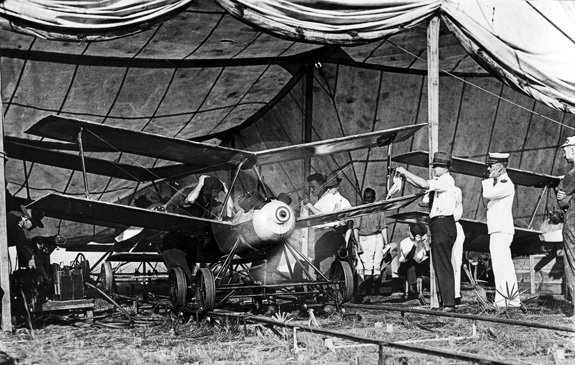
Through much of the Cold War, unmanned platforms remained niche tools—useful for reconnaissance over dangerous territory, but limited by range, endurance, and the technology of the day. They were expensive, fragile, and controlled by major powers with specialized infrastructure.
The real turning point came decades later. As sensors shrank, satellite communications matured, and data links became more secure, unmanned aircraft evolved from disposable scouts into persistent observers. During counterinsurgency campaigns in the early twenty-first century, larger drones provided continuous surveillance over vast areas, allowing commanders to watch roads, compounds, and border crossings for hours at a time. The battlefield grew accustomed to being observed from above.
But the most profound shift did not occur at the high end. It emerged from below. Commercial innovation—miniaturized cameras, lightweight batteries, inexpensive GPS guidance—collapsed the cost barrier. What began as state-controlled ISR platforms became widely available tools. Small quadcopters and loitering munitions blurred the line between reconnaissance and strike. The monopoly on aerial awareness eroded. And with it, the assumption that only major powers could dominate the sky.

BUY THE EAGLE & THE DRAGON NOW ON AMAZON
Why Drones are So Disruptive on the Modern Battlefield
The disruptive power of drones lies less in their sophistication than in what they have done to the economics and tempo of warfare. The conflict in Ukraine has made that reality unmistakable.
Cost Asymmetry.
For generations, militaries measured advantage in terms of platforms—tanks, aircraft, ships—each representing enormous investment. Drones have inverted that equation. On the modern battlefield, relatively inexpensive quadcopters and loitering munitions can cost under $1000 per unit and often as little as $250.
These inexpensive systems have been used to locate and destroy armored vehicles worth millions. A small team operating equipment that costs a fraction of a single artillery shell can threaten assets that once required advanced aircraft to engage. The exchange ratio alone forces commanders to reconsider how they deploy high-value equipment. Protection and dispersion now compete directly with mass and concentration.
Persistent ISR.
The modern battlefield is increasingly transparent. In Ukraine, both sides employ drones not merely for strike, but for constant observation. Trenches, supply routes, and assembly areas are subject to near-continuous aerial surveillance. Units that linger too long in the open are detected and targeted within minutes. This persistent intelligence, surveillance, and reconnaissance capability has compressed decision cycles. Concealment is no longer assumed; it must be engineered and defended.
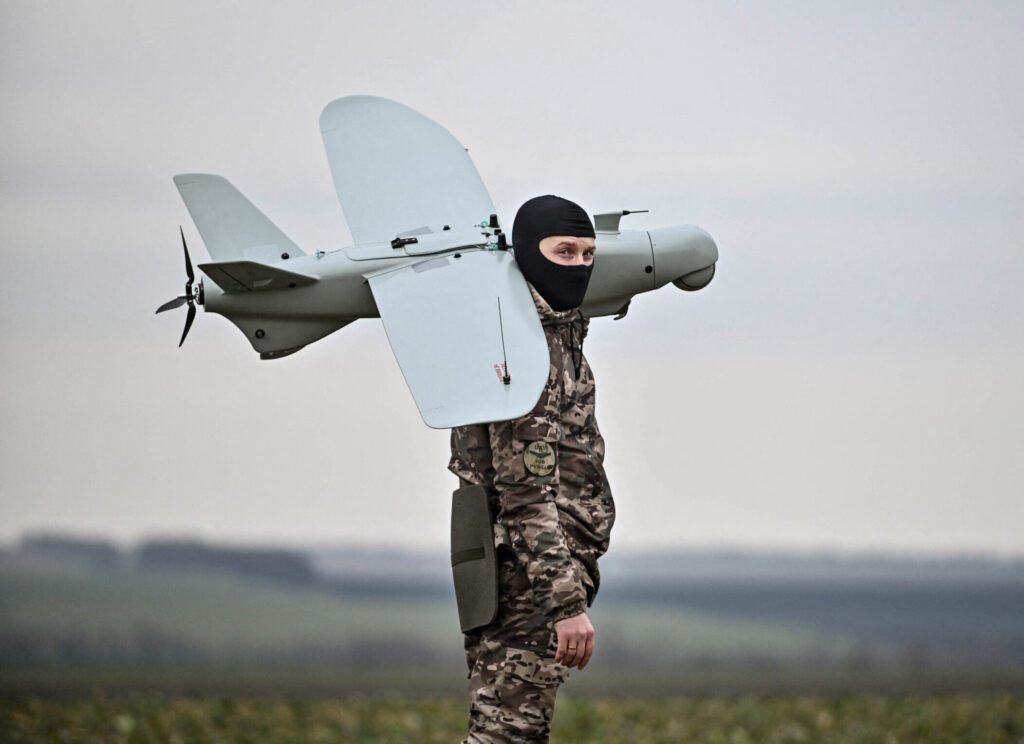
Decentralized Strike.
Drones have also redistributed firepower. Tactical units can now execute strikes that previously required coordination with higher headquarters and dedicated air assets. In Ukraine, small teams routinely identify targets, adjust artillery in real time, and in some cases deliver precision effects directly. The chain between detection and destruction has shortened dramatically. Authority and capability have moved closer to the front, accelerating engagements and reducing the margin for error.
Psychological Impact.
Perhaps most significant is the psychological dimension. The steady hum of an unseen aircraft overhead imposes strain that cannot be measured in equipment losses alone. Soldiers know they may be watched at any moment. Movement is cautious. Rest is uncertain. The presence of drones alters behavior long before a weapon is released. In Ukraine, footage from small drones—circulated widely and rapidly—reinforces that sense of exposure. The battlefield is not only more lethal; it is more intimate and more visible.
Together, these factors explain why the war in Ukraine has been so revelational. It has demonstrated that drones are not a specialized adjunct to conventional forces. They are a pervasive layer of capability—cheap, persistent, and widely distributed—that is reshaping how armies maneuver, protect themselves, and endure under fire.
Why Drones are Not Unstoppable – and What Armies Are Doing to Counter Them
For all their disruptive impact, drones are not a one-sided revolution. They have exposed vulnerabilities, but they have also triggered a rapid and evolving response. No weapon system remains dominant indefinitely. The contest simply shifts.
Layered Defense.
Armies confronting pervasive drone threats are rediscovering a basic principle: survivability depends on layers.
Detection is the first layer. Small radar systems optimized for low, slow, and small targets are being deployed closer to frontline units. Acoustic sensors, optical systems, and integrated air-defense networks are adapting to identify platforms that once slipped beneath traditional radar thresholds. The challenge is not just seeing aircraft at altitude; it is identifying dozens of small objects moving unpredictably near the ground.
Electronic warfare forms the second layer. Jamming and signal disruption have proven effective against many commercial and semi-commercial drone systems. By attacking command links or GPS signals, units can degrade accuracy or force drones to abort missions entirely. In Ukraine, both sides have learned that electromagnetic resilience can be as decisive as armor thickness.
Kinetic interception remains necessary when detection and jamming fail. Short-range air-defense systems, machine guns, autocannons, and even improvised counter-drone teams are increasingly tasked with engaging unmanned threats. Traditional air defense is being recalibrated downward, optimized for volume and proximity rather than high-altitude aircraft alone.
Finally, physical hardening is reemerging as a practical countermeasure. Reinforced overhead cover, protective cages over armored vehicles, and improved fortifications reflect a recognition that some drones will penetrate defenses. Protection, even improvised, reduces vulnerability and buys time.
Dispersion and Deception.
As surveillance becomes persistent, concentration becomes dangerous. Units are adjusting by reducing footprints, operating in smaller elements, and limiting predictable patterns of movement. Large formations that once signaled strength now invite attention.
Decoys have returned to prominence. Inflatable vehicles, false positions, and heat signatures designed to mislead sensors are forcing adversaries to expend drones and munitions on empty ground. Deception, long a staple of conventional warfare, is once again central to survivability.
Camouflage has evolved as well. Traditional concealment focused on visual signature. Modern camouflage must account for thermal and electronic signatures. Concealment is no longer simply about blending into terrain; it is about managing the full spectrum of detection.
The Electronic Contest.
The proliferation of drones has expanded the battlefield into the electromagnetic spectrum. Signals are no longer background infrastructure; they are targets and weapons in their own right. Units must manage emissions carefully, aware that radio traffic and data links can betray location as surely as a vehicle column on a road.
BUY THE EAGLE & THE DRAGON NOW ON AMAZON
Spectrum control has become a prerequisite for maneuver. The side that can protect its own communications while degrading the enemy’s gains disproportionate advantage. In this contest, software updates and signal discipline can matter as much as firepower.
The Adaptation Cycle.
Perhaps the most important lesson is cyclical. Every new capability generates a countermeasure. Every countermeasure produces refinement. Drones introduced unprecedented transparency; electronic warfare responded. Electronic warfare spurred improvements in autonomy and navigation. The cycle continues.
Survivability, therefore, does not hinge on eliminating drones entirely. It hinges on institutional agility. Armies that can observe, adapt, and integrate countermeasures quickly will blunt the shock of new technologies. Those that cling to legacy assumptions will absorb losses until forced to change.
Drones have altered the modern battlefield. They have not ended the contest between offense and defense. They have simply accelerated it.
Strategic Takeaway
The enduring lesson of the drone era is not technological supremacy, but tempo. Drones have accelerated the cycle of observation, decision, and action at the tactical level. Units are identified faster, targeted faster, and forced to react faster. The margin between exposure and destruction has narrowed. Adaptation is no longer a gradual process measured in years of doctrinal revision; it is a continuous requirement measured in weeks, sometimes days.
In this environment, militaries that institutionalize learning will dominate. It is not enough to field new equipment. Organizations must absorb battlefield feedback, modify tactics, adjust training, and disseminate lessons rapidly across formations. The ability to experiment, iterate, and scale countermeasures becomes as critical as the hardware itself. Flexibility is no longer a virtue—it is a prerequisite for survival.
Conversely, forces that rely on legacy assumptions will suffer disproportionate losses. Doctrines built on concentration, static positions, or the expectation of limited surveillance are increasingly untenable. High-value assets deployed without layered protection or electronic resilience become liabilities rather than strengths. The cost of complacency is immediate and visible.
The modern battlefield is becoming more transparent, more lethal, and more unforgiving. Drones have not rewritten the fundamental logic of war, but they have compressed it. In this new environment, advantage belongs not to the side with the newest platform, but to the side that learns—and adapts—fastest.






Is there a planned release date for the 3rd Eagle & Dragon series.
Should be early-April. The wait won’t be too much longer.
So glad you asked and hope you enjoy the series as much as I’ve enjoyed writing it.
John